Friday, June 17, 2016


Port Stephens to Coffs Harbor
24/5/16 – 2/6/16

( Blog readers please note - by left clicking on  photos you will see them full size and a photo gallery below. The same applies for previous blog posts..see blog archives below.)

Everyone we have spoken to with a saline inclination is fulsome in their praise of Port Stephens, and those confined to the terrestrial world share the same view. On our 2010 voyage we were hard pressed to get to Coffs Harbor on the “up” portion of our journey, and on our return, despite earmarking Port Stephens as a “must do” stopover, heavy rain and collapsing conditions, with worse to come, had us scuttle past the entrance to seek refuge in Newcastle, rather than attempt a night entry with zero visibility into a port that was unfamiliar to us. At the time, we attempted to retrieve some of this lost opportunity by hiring a car and driving back to Port Stephens so that at least we got to see what we had missed. As things turned out, we were out of luck on land too, because the day was spoiled by abysmal conditions, with sheets of rain that allowed only glimpses of attractions through the tempest. Even so, adorned in the top end of our foul weather gear, we splashed and slithered our way to enough locations to tell that Port Stephens is a destination of considerable merit, not to be missed next time.

Port Stephens

Now, courtesy of John and Ann Marley, here we were, in row A of the glamorous d’Albora Marina, with its palatial appointments, raft of marine facilities and eateries – Cookie, in the absence of a freezer on Calista had her attention immediately taken by the gourmet ice cream shop (should that be shoppe) – and literally across the road, it was but a doddle up the rise into the charming tourist mecca of Nelson Bay. If we thought back to our home marina at Wirrina, the d’Albora Nelson Bay Marina is, by comparison, on a distant planet and we chuckled about the wind-blown Atco Hut that masquerades as an ablutionary facility at Wirrina compared with the personal staterooms at Nelson Bay; leading off the relaxation lounge, with their individually tiled appointments, gleaming vanity areas, glamour mirrors and personal hair dryer. At Wirrina, if you want to dry your hair, you stick your head outside the dunnies and count to twenty…or more often, five, when the sou-easter is whistling down the valley. To get to Calista in Nelson Bay, the stroll down A Row saw one passing a line-up of wedding cakes afloat, which if sold in a lot, could purchase a brace of African Republics. Sadly, there were few masts to be seen, and we wondered if the multi-tiered luxury cruisers found here are more often show than go.

Spot the sailboats!

You would think that here in the zenith of living afloat, we would have become lounge lizards, seduced by a program that flowed from latte, to tapas, to canapés with a view, washed down with selected extracts from the Hunter, Margaret River, or even the Barossa; with a window table selected for sunset. Not so. Although we noted the great range of temptations close to hand, and the menu at Mavericks on the Bay, which lords over the marina, is acceptably and fairly priced, our focus was taken more by what we had seen on our approach to Port Stephens and what we soon gleaned from the friendly staff at the Information Centre, which was - you may have guessed - only a short stroll away. Yes, we had some vital voyage-related issues to resolve before we left Port Stephens, which would steal slabs of our time, but in amongst this we wanted to see more of the wild side of Port Stephens than we had been able to glean from our vantage point out at sea.


Port Stephens is a substantial waterway, greater in area than Sydney Harbor, and offering recreational opportunities afloat that, like Lake Macquarie and the Pittwater, could mean that one might be delightfully content without ever putting out beyond the headlands to the open sea. Given our tenure in A Row, and the need that we had to be close to both facilities and to on-board technologies, we resolved to stay put in the marina, do some exploring by land and maybe see some of the anchorages of Port Stephens on another day. The clincher in achieving a work and play balance at Nelson Bay was to find, again courtesy of the Information Centre ladies, two brochures of great value to us: the Port Stephens Bus services timetable that would give us scope to visit a range of places beyond the marina, and the Tomaree National Park brochure that revealed a network of coastal and forest trails that looked just there for the walking.

Added to the list of features at Nelson Bay was the presence of two fresh fish outlets alongside the marina, giving us the opportunity of dining aboard on fruits of the sea without getting a line wet. The broader marina complex is also home to the fishing fleet, the Police and Marine Rescue vessels, a raft of tourist boats and the ferry that plies a regular trade across the harbor to the centres of Tea Gardens and Hawks Nest. Offerings such as snapper cutlets, sand whiting fillets and whole pan fried flounder – Cookie took a little convincing re the flounder and wanted to know if the beseeching eyes of these creatures had been attended to in the gutting process  – graced the griddle on board Calista. Whatever the good patrons of Mavericks on the Bay were enjoying, our on board marine fare, complete with lightly tossed green salads, olive oil brushed potato and sweet potato wedges, was incomparable.

Having been regular visitors to “fisherman’s cooperatives” along the NSW and QLD coasts for our on-board dining in 2010, we have noticed, this year, a concerning trend. We are very fond of “Flake”, gummy or school shark fillets, which are delicious steaks of the sea, and have been the staple of good fish and chip shops for decades. This year though, our imprecise survey of fish outlets has shown that flake, as we have known it, is rarely seen these days on trays at the fishmongers. The sad conclusion is that we have fished the species of potable sharks to oblivion. It is clear that the science of sustainability being aligned to catches is missing; and that those in authority have done little to address the disappearance of some species from our seas. A result of this is that some species, once discarded as offal, are now promoted as premier table fare. Humble and harmless shovel nosed rays are now swept up in nets; meagre fillets are separated from their tail sections, and sold as a variety of “flake”. At Nelson Bay the sign of “flake fillets” had me excited until some further quizzing revealed that the “flake” was really chunks of shovel nosed shark, fine to use if you were re-soling your walking boots. The same applies to other species such as leatherjackets, once condemned to the status of Crayfish bait, and now proffered as premium fare.
Anyone for "Flake"?

Up in Nelson Bay though, there was another gourmet outlet that we had noted in 2010, and had more than proved its sustainability over time. The term “Pie Shop” does not conjure up all that much, unless you are referring to Red Ned’s Pie Shop, Nelson Bay that deserves a status above and beyond all other outlets for baked produce. Red Ned’s is a bakery that needs no interior decorating, because its walls are completely adorned with trophies and banners, won over the last 18 years from competitions all over Australia. Prevarication is a problem at Red Ned’s, because apart from the range of specialty Pasties, Sausage Rolls and “favourite” Pies, is the Gourmet, Seafood and Vegetarian Pie range, over 50 in all, that has to be seen, and tasted to believe, and leaves  the client with impossible decisions to make. Take wagyu Japanese marbled beef, with onion and cheese: Thai authentic green curry lamb with capsicum and shallots; scallop and prawn in honey lime and chilli sauce; crocodile with baby spinach, mushrooms in white wine sauce and deluxe vegetarian with 9 hand cut vegies in hollandaise, garlic and pesto seasoning.  Wow! Yum! I couldn’t help remembering growing up in Port Elliot, where if you strolled into Willats’ Bakery, Mrs Willats would keep it simple with the time honoured line “what’ll it be, Pie Pasty or Sausage Roll?”. I wonder what Ernie Willats would have made of Red Ned’s.

Decisions.. Decisions!

On board, our frustrations in achieving a sat phone driven connection to the internet for offshore weather and communications was growing apace. Try as we might, the signal from our highly regarded Iridium 9555 proved not strong enough to link to either email or weather sources. Experts from afar were called to lend a hand, but the goal of achieving a reliable connection via this technology to the outside world proved elusive. Cookie has been in the driver’s seat of this quest, and to quote her verbatim…”this is doing my head in!!!” Hours slipped by on board Calista and everything we touched turned to clay. Happily, though we were well positioned to seek relief from our screens and to head out, off the boat to the outside world. Call it respite care for non-geeky sailors if you like.


The day after our Nelson Bay arrival saw swells of up to 5m forecast and we decided that with deft use of the bus timetable and the Tomaree National Park map, we could head for Fingal Bay, and with luck, take some walking trails to see the spectacular coastline for ourselves. Compared with the hoopla of Nelson Bay, the solitude of the Tomaree National Park, and the grand vistas that it offered, were a delight. Many more hours of hand wringing and peering at screens might have injured our mental health. Maybe those who suffer from technological morbidity could do as we did, and on the Big Rocky Walk, watching huge seas pummel Little and Big Rocky islands; hurling cascades of spray aloft, they, like us, might find peace of mind in the wilderness. There is nothing like salt spray and wind in your hair to restore equilibrium.
Spectacular coastline south of Fingal Beach

Flushed with the success of our outdoor activity, we embarked on more. Another foray saw us head to Shoal Bay, the next bay around from Nelson Bay ,and next to the Port Stephens entrance, from where a hike to the top of Tomaree Head offered stunning views to all points of the compass. From here, having a sea eagle like elevation, our attention was drawn to Zenith, Wreck and Box beaches that were crescent shaped indents in the coastline extending to Fingal Bay. At Fingal, it might be possible to nimble our way across the Fingal Spit, and in spite of the dire warnings about being swept away by seas covering the isthmus, get to the Lighthouse on Fingal Island.
Great walk and views from Tomaree Head

In between, though, we planned a weekend foray to Solder’s Point, deeper into Port Stephens, where another marina is to be found, that might be a valuable referral point on another occasion. The Sunday bus to Soldier’s Point required a stopover and bus change a Salamander Shopping Centre, a facility that, in spite of attracting a host of locals seeking retail entertainment, had little to maintain our interest or enthusiasm. After a trundle down the peninsula in the Soldier’s Point bus, we arrived at the marina to find it more like a two-story restaurant, brim-full of people seeking gourmet entertainment to while away their Sunday. We are folks who are not wedded to lunchtime dining, and the thought of a pricy nosh-up, leaving us replete, dreamy, and lighter of pocket, had us seeking solace in a middling café around the corner. We just had time for a bite before catching the bus, when, in the process of seeing good our bill we were aghast to see our cherished bus streaming past at a merry clip, in the direction of our intended travel. Rushing outside and waving like castaways on a desert island was to no avail….and worse was to come, beyond admitting to my minor mis-reading of the timetable; on breaking the news to my travelling companion that because it was Sunday, the next bus was two hours away!! Cookie is a solution seeker and her response was both immediate and to be expected….”we’ll walk”. Then, with the realisation that walking might see us still at it beyond sundown she had plan B in hand in a trice….”we’ll hitch!.....hitched my way around Europe in the 80’s…and we can hitch our way back now!” She strode off, arm outstretched like a railway signal whilst mine was extended limply, like a spinach leaf left too long in the sun. On we trudged, as our confidence and ebullience steadily eroded. Car after car swept past, judged us as inappropriate, and drove on. No dreadlocks, no piercings, no black t-shirt with skulls, and not visibly affected by substance or drugs; we were shunned. What has society come to when a respectable gent and his more than respectable partner can draw no response in their hour of need? Then…a car stopped. A lovely lady hailing originally from back of Dubbo took pity on us and offered us a lift. What’s more she was headed for Nelson Bay and could drop us off, just abeam of the marina. In the end we got back before the convoluted bus process via Salamander, met a charming lady who typified everything that is “country”, and we had time to investigate a glass or two to restore our jangled nerves before sunset. I resolved to triple check bus departure times in the future.

Now what time was that bus?!!


Our last Tomaree excursion, achieved via a carefully constructed connection with the local bus, took us to Shoal Bay from where the walking trail to Wreck and Box Beaches originated. These beaches, reached after an enervating stroll through the forest, were every bit as good as they had appeared from Tomaree Head. With a warm sun and gin-clear water a swim here was tempting, although with the tide on the turn; to swim would mean that we might not have time to cross the isthmus to Fingal Island. A swim is a swim, but crossing the isthmus was something else!
Wreck Beach

The Isthmus

On our arrival at the spit, with the seas of earlier days in retreat, the stroll across appeared a breeze and what was more there were vehicles on the Fingal Island side that underlined its viability. On arrival there, with our feet nearly dry, we came across a group of net fishers intent on getting a cast around a shoal of sea mullet, or black bream, that were schooling just off the headland. They were using a jet boat for net deployment with the ends of the net hauled ashore by vehicle. We sauntered across to say hello and they were surprised to hear about our background of jet boats, mulloway fishing on SA’s wild Coorong beach, and experience of setting heavy nets in equally heavy surf. They referred to a SA fisherman who had been on the ABC Landline program, about net fishing off the Coorong Beach, and were astonished, again, that our good friend Alistair Wood, known fondly by us as the Mulloway King, was the very same identity. It was a one in a million connection because, with the isthmus profile deeper in recent times, they had not been fishing at this spot off Fingal Island for the last nine years.
Retrieving the net

Fingal Island is not huge and a short walk along a clearly marked trail saw us at the Point Stephens Lighthouse, a regal structure with bright blue trim that we had ogled from out at sea. Sadly, the equally grand keeper’s cottages, with the head-keeper’s residence, complete with its bay window overlooking the cape, was gutted by fire in the early 1990’s and the residences are but a forlorn relic of their former glory. If we were well heeled tycoons we would love to see the buildings restored to what they used to be. Good company, a roast in the oven and spray leaping from the rocks beyond the lighthouse….we wonder if tycoons are as attracted to these things as we are.
Relics of a a bygone era at the Lighthouse


Incoming tide and threating skies as we returned across the Isthmus


Our last excursion in Port Stephens was the easy stroll from Nelson Bay to Nelson Head, to visit the Port Stephens Marine Rescue Centre, sitting up on its position of advantage overlooking the port entrance. Manned 24/7, the facility is impressive with facilities that underline the importance placed in volunteer Marine Rescue, both by government, and by the broader community. We thought of the fabulous work done by Carol Miell of American River VMR, and Garry and Sue Smith of Tumby Bay VMR, back in SA, and how their threadbare funding was light years away from what we now saw in front of us. The MR Officers, there were three on duty, were very welcoming, and willing to discuss any aspect of their work in the area. They were proud of the work done by their group, sometimes responding to emergencies during horrendous conditions out at sea. Earlier this year, yachts returning from the Pittwater to Coffs Harbor Yacht Race, were hit by a terrible storm when returning south; one yachtsman was drowned and the Marine Rescue vessel was knocked down by the enormous sea.  To us, with weather events like this now predicted and not random, we wondered what the yachts were doing out there in the first place, especially as the incident occurred on a Tuesday and concerns about the weather prognosis were shared with the boats at Coffs on the Sunday before. Hearing the harrowing tale of what eventuated, with Marine Rescue personnel clearly putting their lives on the line in the process, we reflected on the differing mentality that exists between racing “yachties” and cruisers like us. We would have stayed in port.

Port Stephens Marine Rescue


Back on board, the need to head north, combined with a temporarily fine weather prediction, had us readying Calista for sea. Following our discussion at the Marine Rescue centre, a detailed look at the weather outlook back on board showed the ominous development of a weather system in a few days’ time, out in the Coral Sea but heading for the NSW coast. Although showers were currently forecast, winds were expected to be light, giving us the opportunity for a comfortable passage, north to Coffs Harbor; a voyage of 165 nm that would take about 30 hours at sea. The strong westerlies of previous days had dissipated, but the chill in the air had an unmistakeable sniff of winter.

Last sunset at Port Stephens


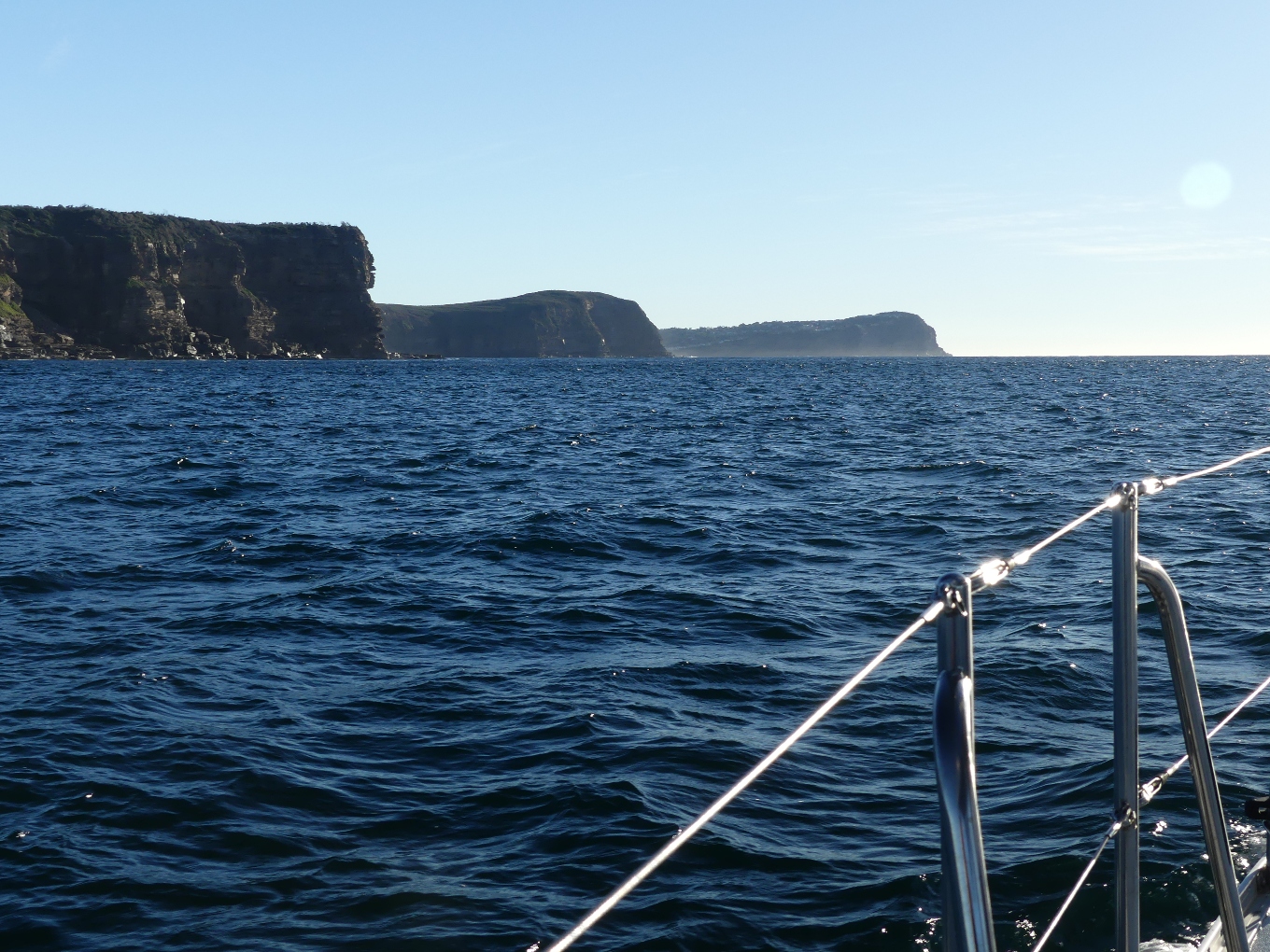
We were away and out of the d’Albora Marina, before many had stirred and well before the first coffee was stirred at Mavericks on the Bay. The passage beyond Tomaree Point was disturbed with an outgoing tide in conflict with a light onshore wind, and what the passage would be like in a dedicated Nor-Easter, against an ebbing tide was horrible to contemplate. Soon, however we were free from the area of confluence and making between Cabbage Tree and Boondebah Islands, we set a course for a point off Seal Rocks. With our at sea routines in front of us, we set a double reefed main, engaged the autopilot, and attempted to get some rest in between taking turns on watch.

Not far out of Port Stephens, beyond Hawks Nest and Providence Bay lie the Broughton Islands, where island anchoring offshore, common in South Australia but not so in NSW, is possible. We glassed the islands but did not linger, with a long night, and some, in front of us before we reached Coffs Harbor. Of more appeal, with its beach anchorage sheltered by Sugarloaf Point, was the Seal Rocks anchorage; just the thing if the weather was holding fine from the South or Sou-West. For us though it was not the time to delay and explore, and we made our way past Seal Rocks, and later Cape Hawke, to see the wink of the Crowdy Head light, off our port bow as darkness fell.

Seal Rocks Lighthouse
Another amazing sunset


Port Macquarie, like a number of the prominent Marine Rescue stations, is manned 24/7, although probably “staffed” would be a better term as these days, as, like Carol on Kangaroo Island, female voices calling the shots on the airways is becoming more common. On leaving Port Stephens we were asked to nominate a coastal station, somewhere near the mid-point of our passage, to call up and register our progress. We drew level with Port Macquarie at 1am, and despite some reticence from us in calling at such an untimely hour, a chipper voice came up in a moment or two, deflecting our apologies for disturbing his peace, and saying that our call was a good excuse to put on the kettle. Some cruisers choose not to log in with the Marine Rescue network, although we prefer to have our presence known to the professionals ashore. If something went wrong out at sea, they have our particulars, and in the event that we did not reach our destination, time would not be lost in starting a search for us. Our experience is that if we say we will be arriving at a location at a designated time, and we do not radio in, they will place VHF calls out for us and will start calling us on our mobile phone, as this contact is part of the standard log-in procedure. With our home port far away, we appreciate this.

Snug in the lee cloth berth off watch

Through the night we could see that something was brewing out to sea, but in spite of faraway flashes of lightning, nothing malevolent presented itself and we emerged into the new day off one of our favourite NSW places, Smoky Cape. With its Trial Bay at Sou West Rocks and a fascinating past as a penitentiary by the sea, it would be good to drop our anchor here, although thunderheads out to sea, lit by the ochre rays of the new day, kept our focus on the fresh waypoint past Nambucca Heads, and battling the notorious East Australia Current; the topic of much fun in Finding Nemo, but a bane to any cruising yacht making to the North. The EAC bares its fangs between smoky Cape and Coffs Harbor, but in our corner on this occasion was a sprightly breeze from the SW, which allowed us to trundle along past the unmistakeable Hat Head, before the islands off Coffs hove into view.


The southern breakwater wall at the outer harbour entrance
On approach to the Marina entrance

We rounded the Coffs Harbor breakwater and made for berth D42, at the behest of Marina Manager Elise who, when we presented at the Office, suggested that given the ominous weather forecast for the weekend, with gale force winds, sheets of rain and seas building beyond 6 metres in height, having our bow to the weather would be a very good thing. We had a day to prepare for the tempest, and do all that we could to be ready for the storm when it arrived. In an ironic touch a sign near the port facilities proudly declares that works are about to start on raising and strengthening the north-east facing breakwater, the barrier that will bear the brunt of what is to come. Previous storms have seen seas crash over its wall to cause considerable damage to the marina, and in the marina office is a photo taken during a blow that shows the breakwater completely smothered by an enormous sea. With locals telling us that “this one could be the worst one yet!” we felt a growing sense of apprehension……as our ship’s barometer began to fall.  


Monday, May 30, 2016


Lake Macquarie to Port Stephens
18/5/16 – 24/5/16

( Blog readers please note - by left clicking on  photos you will see them full size and a photo gallery below. The same applies for previous blog posts..see blog archives below.)

Planning a voyage such as this one has been made more complex by all that is involved in leaving Australian waters for another country, in our case, to New Caledonia and Vanuatu.  In our first post of this blog we spoke of journeying to these destinations on a “big ship”, in this case P&O’s Pacific Pearl as invaluable background for what we are soon to undertake. There have been many other things to investigate, before we consider ourselves remotely ready to go. Linking with others who have been to these places is invaluable, and in January this year our fine Port Lincoln sailing friends Jonathon and Wendy Newbury put us in touch with medical friends from Newcastle,  John and Ann Marley, who fortuitously sailed to this part of the south-west Pacific in 2015. Coincidentally, John and Ann, on their 37’ Beneteau Oceanis, Essex Girl have future plans to sail to PNG’s Louisiade Archipelago, a fabulous string of tropical isles that we have visited in 2008 and again in 2010. It was natural then that we have had things to share about these respective destinations, and before we set sail from SA we exchanged cruising notes, and marine charts with each other and resolved to try to meet when heading north, in the vicinity of Newcastle. When we found that Jonathon and Wendy planned to join John and Ann about the 23rd of May to jointly sail north in the direction of the Whitsundays, we decided to do our best to connect with them prior to their departure. We were very much looking forward to meeting John and Ann, and this was uppermost on our minds as we slipped from the mooring at the Swansea Bridge, and made our way down the channel on the short leg to the major port of Newcastle.  
Leaving Lake Macquarie entrance

Beyond Swansea a long sweep of coastal dunes hides the bustle of Belmont from those out at sea until the ruddy bulwark of Red Head marks the resumption of coastal cliffs and bays that end with Nobbys Beach and Nobby Island, which lie abeam of the breakwaters that shelter the entrance to Newcastle. Many will remember Nobbys beach as the scene of the stranding of the 76,000 tonne Pasha Bulker, in a gale in June 2007, and the remarkable efforts by all and sundry to re-float her and return her to the high seas before she broke up. Often these marine dramas are played out in remote places, away from the public gaze, but this incident took place not more than a short walk from Newcastle’s Town Hall, with the good folk of the city having front row seats. As we left Nobbys Beach to port it was in conditions that could hardly be more benign. We were grateful for this.
Nobbys Beach & Nobbys Head

The port of Newcastle is one of Australia’s busiest, and entering here often sees a small ship like ours sharing the channel with a steel monster and its clutch of tugs fussing in close attendance. Newcastle is in fact the world’s biggest coal export port although with growing concern about the role of burning coal and global warming, this may not be the point of pride that it used to be. Our first entrance here in 2010, saw us miss the last of daylight and having to squeeze past an immense coal ship in the entrance, complete with courtiers, heading seaward.  This time, using our AIS to assist, we were delighted to see a VBS, very big ship, depart the port and head south for the other side of the world. In drawing level with the breakwater “leads” we were relieved to see that, almost literally, the coast was clear.
On approach to the Newcastle Cruising Yacht Club Marina


After tying up at the Newcastle Marina and exchanging the requisite paperwork and payment – it costs $240 per week to stay at the Newcastle Cruising Yacht Club, with excellent facilities available either there or near at hand – we set about working on the endless lists of tasks that were underlined and in italics in Cookie’s notepad. Newcastle has long been a worker’s city, and we would be working here too, for much of our stay. What we needed though, was some mobility to get to places that were not close to hand, and we were fortunate in that, after meeting John and Ann over a coffee, and having them accept our invite to dine on board Calista, they let us know that we could make use of their daughter’s car whilst in port, given that she was currently overseas in London. This was a kind gesture from a fine couple of kindred sailors.
Nobbys Beach

Having transport also allowed us to “down tools” for parts of each day to see Newcastle, to make for Nobby’s Beach for a plunge in the surf and, predictably, to head for the Newcastle sea – baths to get in some daily laps to keep ourselves nimble. Our fondness for town “Baths” has grown on this voyage, with these seaside attractions dating from days before modern pool technology where clever engineering created shore-side pools that were filled and refreshed by the natural processes of swell and tide. Once built, these facilities largely ran themselves and provided a safe place for many people to go “sea bathing”. These were the days of striped jackets, straw boaters and ladies in parasols. With their ornate facades, baths like those at Newcastle have played a key role in creating a fondness for the sea in Australia that today we call “beach culture”. Certainly, plunging into the Newcastle 50m sea-pool was very different from the Olympic Pool in Homebush. Unlike the 26 degrees of Thorpie’s kingdom, the Newcastle pool had nudged down to 18 degrees and swimming 20 laps left one with a gathering chill. Although this pool has seen better days and many moons have passed since the cement steps of its amphitheatre have brimmed with spectators, the pool does have some remarkable features, such as the numbers of fish that have made their home there and look up with curiosity as you pass overhead. Amongst the fry was a trio of substantial Bream that looked as though they were doing just fine in their predator-free home. We have no idea how they got there.
The Ocean Baths, City Beach


 There were uplifting moments for us too, such as attending a program of evening lectures at the Newcastle Town Hall on Humpback Whales and Seahorses; by marine aficionados, around the theme of preservation of oceanic species. We were well aware of efforts in recent decades to restore the numbers of Humpbacks in Australian waters, but the compelling story of preserving populations of seahorses in Port Stephens to the north, was truly enlightening.  Beyond this though, to be able to head into town for a product or part, and to head to the shops to re-supply made life so much easier, especially, had we hired a car, it would have sat idly in the marina car park for much of the time whilst our heads were down in anchor wells, bilges, lockers and the like. At times on board our boat it looked as though we had been in a blender, with tools, gear, locker contents and equipment strewn in all directions.

We were saddened to see that central Newcastle, which suffered considerably from the serious earthquake that devastated the area in1989, killing 13 people and injuring many others, has left many buildings too costly or complex to repair. To us it seems as though by one means or another, locals have shifted their enterprise and their focus from the centre of town to the suburbs. Empty shops, faded facades, and businesses that struggle to make ends meet seemed to us to be a hallmark of the centre of Newcastle City, 2016.  Above all though, on passing by the grand Newcastle Railway Station, we were appalled to find that a recent “development” plan has seen the rail from Sydney terminated some way out of town, with plans to erect high rise properties on railway grounds, winning the day over strident opposition to the closure from locals. The power of money has won the day. At least just alongside the old station, where shuttle buses have replaced the trains, the legendary “Café d Wheels”, an iconic Pie Cart that has seen to the internal needs of locals and visitors since 1945, is still plying its gastronomic trade. Its gourmet piece de resistance is a pie – flavour of choice - topped with mashed potatoes, mushy peas and gravy. I can be now included amongst its converts and devotees. Cookie cannot. Should the developers place their grimy sights on the “Café d Wheels”, we think that the people of Newcastle will take to the streets, and march upon Town Hall. The tomato sauce will flow!
A very happy Colin!

With our “tasky” regime at the Marina, days skipped by and we were looking forward to seeing Jonathon and Wendy again before making ready for sea. Their time in Newcastle was to be fleeting, with John and Ann ready to head for Port Stephens and their imminent departure to the north. This left one opportunity for us all to dine at the Yacht Club; spend a little more time with John and Ann, catch up with some old friends from Lincoln, and chat - until the staff called time on our conviviality by pointedly clearing tables and shutting the doors. It had been a fine, but all too fleeting night in the Port of Newcastle.
Servicing the anchor winch

Oiling the teak Hungry Board
 
Dining at the Yacht Club with Jonathon, Wendy John, Ann & family


Back on board the fresh southerly change which had swept Newcastle’s dusty air to the north brought with it strong wind warnings to the Hunter Coast. Closer inspection though showed that whilst further out to sea the winds would be formidable, closer to the coast they were a little easier and would allow us to depart Newcastle with fresh airs on our stern quarter, providing us with the opportunity to sail the 32 nautical miles across the Stockton Bight to Port Stephens. There was another incentive as well. The BOM forecast for the Hunter and nearby coastal areas carried a “marine caution” for the next two days relating to a developing 3-5metre swell that would make conditions potentially hazardous for vessels entering or leaving ports. Because we had not entered Port Stephens before, we were wary about entering there in adverse swell conditions, in spite of cruising notes that suggested that due to the depth of water in the entrance channel, swell size should not be a concern.
7.5 knots!!

With Calista bearing a reefed sail pattern the next morning saw us make our way down the ship channel and out to sea. Ahead, the ocean appeared in profile like corrugated iron, and the sharp WSW streaming off the dunes of Stockton Beach threw up a top sea that ran contrary to the building ground swell, and caps of white were all about. Our prudent sail selection had us in good stead though, and after setting our headsail we romped away in the direction of Port Stephens. This was a sleigh ride with hand – steering ruling the waves. Times like this have been in short supply on this trip, with either too much or too little wind being the norm, but this time we shared the helm and allowed our Swanson 36 to show what she was capable of delivering. The swell had built to an extent that, when a “set” was upon us, the wind fell to a zephyr in the “valleys” and hit us with conviction up on the crests. In no time though, it seemed, the fans of spray off Fingal Point and Big Rocky Island had us scanning the coast in awe, and the lighthouse on Point Stephens signalled that the turn to port into Port Stephens was not far away. On rounding Point Stephens and with Tomaree Head, the entrance to Port Stephens closing, the swell was blunted and it was clear that our concerns about waves in the entrance channel were groundless. In fact, of more concern to us was the out-flowing tide backed by the wind, now on our bow, that with our sails furled, and motor engaged had our speed reduced to three knots. Getting in to Port Stephens would be a bash.

Approaching Tomaree Head and the entrance to  Port Stephens


In the calmer waters near Nelson Head, with our destination almost in view, the sight of a sleek cruising yacht hoisting sail and preparing for sea had us reaching for our binoculars. It was Essex Girl, with John, Ann, Jonathon and Wendy on board, making for the entrance and an overnight passage to Coffs Harbour. Instead of tying up alongside our friends at the Nelson Bay marina, we were about to wave some hasty farewells as our two ships passed, and we made our way to Essex Girl’s pen, which, by the kindness of John and Ann, might be our home for a time as we readied ourselves for our own passage to Coff’s Harbor. Our voyage to New Caledonia and Vanuatu was getting closer, but still there was a great deal to do before we would be ready to go. In the meantime, in Port Stephens we might get a chance to take in some of the highlights of this exquisite destination. As a premier drawcard for visitors, both afloat and on land, we had heard a lot about Port Stephens and now hoped to see some of it for ourselves.

Farewell Essex Girl

Sunday, May 22, 2016


Broken Bay to Lake Macquarie
13/5/16 – 17/5/16

( Blog readers please note - by left clicking on  photos you will see them full size and a photo gallery below. The same applies for previous blog posts..see blog archives below.)

The russet hues on the new day were apparent in eastern skies, but we had beaten the sun to it with our cabin lights radiating a warming glow below, the kettle simmering; and with a last check of the BOM website underway before we ventured outside to ready the ship for sea. Days were measurably shorter now and as the breeze had lost it purpose in the late evening, the settling airs off Little Patonga Beach had gifted their moisture to the decks of Calista which now glistened with dewdrops in the dawn. Bare feet gave way to ugg boots, and a warming windcheater was required to deflect the chill of the air and underfoot.

Another beautiful sunrise - Little Patonga Beach

We were far from the first up though, as across Broken Bay to Flint and Steel Point, a runabout with its ruby light to port was hurrying at pace in the direction of Pittwater. It had been good to anchor in Patonga Beach after the regimentation of moorings in Cowan Creek; undertaking the process of selecting an anchoring spot, considering the swing on the chain that could be required at night and the joint efforts of the bow and the helm in seeing the chain laid in accordance with the wind, and tackle set to provide reassurance through the dark hours. Picking up a mooring is secure we admit, but anchoring out is real cruising to us.


Lion Island


With our chain and anchor retrieved we rounded the port light at the entrance to the bay, and made for Lion Island and the entrance to Brisbane Water, before keeping a watch for East Reef, a shoal that might provide a challenge for an unwary crew making to the north. We reflected on the diverse and extraordinary experiences of recent times, of Port Hacking, Sydney Harbor, and now the waters accessed via Broken Bay: a trilogy of destinations too fulsome to see in one autumn, one year, and maybe in a lifetime on the water. You could live in this region from a callow youth to a seasoned salt and still be discovering special places.


First Second & Third points

These were fleeting thoughts though as upon rounding Third Point, and with Second and First Points in view, the sandstone cliffs so typical of the Sydney coast were duplicated, except where they had been breached by nature to gift us the beaches of Killcare, McMasters Beach, Avoca, Copacabana and Terrigal, and there was much to see. Sailing had been challenging to this point with some steady breezes from the WNW giving us the chance to hoist everything and romp along, followed by failing airs which saw us ignite our motor to assist, before, as the zephyrs tended northerly, we doused our headsail and made distance by motor and main alone.

Wonderful to be sailing!


Perched atop Norah Head, the major coastal feature before Lake Macquarie, is its impressive lighthouse and clutch of former light station cottages. Happily, like other lighthouse precincts elsewhere, Norah Head has a new life today, via “getaway” accommodation and functions, for weddings and the like. In the season, the headland is a popular whale-watching location as the Humpback whales make their annual migration from the Antarctic to tropical Queensland and return. Now fully protected, these leviathans are seen these days in ever increasing numbers. There is some similarity in the annual migration of the whales as far as the Whitsundays and the annual migration of cruisers and yachts from NSW and southern Queensland waters to tropical climes north of Fraser Island. Humans and cetaceans both prefer warmer seas to cold ones it would seem.
Norah Head lighthouse

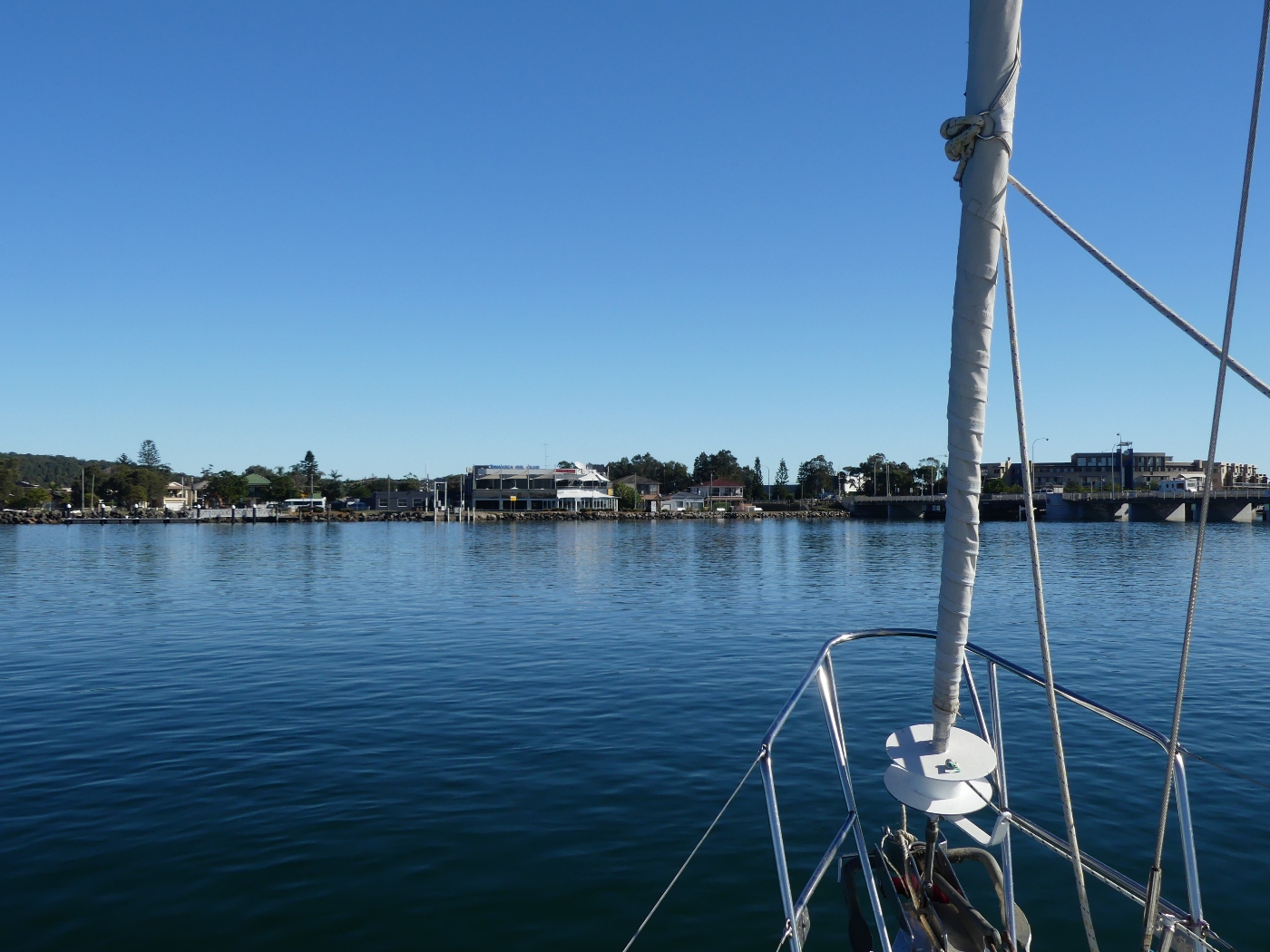
It is not far from Norah Head to Moon Island off the entrance to Lake Macquarie where entrance to the Lake, for keelboats such as ours – we draw 1.8m – is governed by the tide, and gaining access to the Lake is via a pre-booked opening of the Swansea Bridge. The wind, that had been sluggish at best, had now disappeared and the last portion of our journey from Broken Bay required the motor for us to keep up our schedule. Bridge openings are arranged via Marine Rescue Lake Macquarie, and with a 1400hrs booking in place, we needed to arrive in time to pilot our way down the channel following the lead beacons between the breakwaters, and arrive in the basin out from the bridge for the opening. When last in the area, in 2010, we had hired a car and driven to see the entrance, and visit the Marine Rescue station which perches above the channel, in driving wind and gale force winds. Our arrival this time could not be a greater contrast, with a calm sea, azure skies and no swell to speak of. In no time at all it seemed, the wings of the bridge creaked open, and with dozens of cars with their disgruntled occupants banking up on either side, we slid through into the channel leading to Lake Macquarie.


On approach to the Swansea Bridge
Safely through the bridge....now the channel & "The Drop-over"

So far, so good, we thought, but the greatest challenge still lay before us. Locals call it “the drop-over” which in truth is a nasty, shifting sand-bar further up the channel, that at low tide would prevent our passage, but now, with a rising tide nearing full, we should be able to scrape through. Understandably, this troublesome impediment requires frequent dredging, and sometimes sand accumulation closes off the lake for keelboats completely. We had been at pains to study the tides at the Lake Macquarie entrance in detail and although we came close to nudging Calista’s bottom in the shallowest part of the channel, soon “the drop-over” was behind us and the lead beacons deposited us into the broad expanse of the lake where depth was not an issue. Curiously, in spite of the tidal flow in the Swansea channel, such is the volume of water within the lake that there are hardly any tides in the lake to see. We could have literally headed in any direction because at 104 sq km, Lake Macquarie is Australia’s largest sea-water lake, and with a host of bays to choose from, the options were nearly endless. All of the vessels in the greater Sydney area could be accommodated in Lake Macquarie, although getting them all in would create great angst for those waiting at the Swansea Bridge!


Negotiating the well marked channel, keeping red to port ( left)

On our way up the coast we had considered our options upon entering the lake, and now it was but mid-afternoon and there was plenty of time to find our way across Lake Macquarie to the town of Wangi Wangi, blue-collar to its bootstraps and stridently parochial, even on a good day. Alan Lucas’ guidebook had referred to the fine anchorage available in the bay off Wangi Wangi, and that if one was lucky; a visiting yacht might tie up on the pier outside the Wangi Wangi Worker’s Club, the social and cultural hub of Wangi. Considering this, we crossed the Lake in good speed before feeling our way into Eraring Bay, where the worker’s club jetty was already accommodating a motley selection of vessels, some sleek and expensive, others modest and functional.  Our arrival saw a couple of blokes off a house-boat sit down their stubbies, and rally to catch our lines. Their cheery and easy going welcome was typical of Wangi Wangi. This is not to say that blue singlets totally ruled the day for nudging into the jetty was the opulent motor cruiser Debjohn, that we recalled taking pride of place in the Bobbin Head Marina, Cowan Creek. We had seen them earlier in the day, low down and heading north in torrents of spray, off Norah Head and would never have guessed that Wangi Wangi was where they were headed. It would have been Sanctuary Cove for them we thought. Not so.

Secure at the Wangi Wangi Jetty


After a stroll into town and making a $10 payment to the Club for our overnight berth, we dressed for dinner and made our way into the redoubtable WWWC. The Club was well patronised; “meat tray night” was how one local explained it, but for us the day had been a long one, and we settled into a fine meal with blue-collar prices, before wending our way back to our ship, to plan some excursions to the far reaches of Lake Macquarie in the coming day or two First though, we wanted to take the opportunity to catch up with some old friends who had urged us that next time we passed through these waters, we must come in and see Lake Macquarie.

In 2010, in the Coomera River, just upstream from Sanctuary Cove on the Gold Coast, we met Kel and Helga Korsman off the fine catamaran Mojo, who, like us were headed to take in the Sanctuary Cove Boat Show, and like us were headed north to Townsville and out to the Louisiade Archipelago, across the Coral Sea, in the waters SE of Papua New Guinea. We connected with Kel and Helga on a number of occasions up the Australian Coast, in the Louisiades, and on our return to Australia. We shared some wonderful and some challenging times, and came away liking Kel and Helga, both for their approach to life and the fine people we found them to be. Down on the southern portion of the NSW coast we had called them declaring our intention, weather permitting, to make good our declaration, that next time in waters north of Sydney, we would try to include Lake Macquarie in our list of destinations. They live overlooking a waterway, not far from the Swansea Bridge, and we arranged to head back across the Lake in the morning, following Kel’s directions, to anchor off the lakeside suburb of Belmont, and to spend some time reconnecting and reminiscing. It was great to see Kel and Helga again, and although we had not crossed paths since 2010, it was as though our shared experiences in a faraway place had happened only yesterday.
Kel & Helga's waterside home

Lake Macquarie has been home to Kel and Helga for many years, and because we have similar interests, we took the opportunity to have them mark a number of features on our map of the Lake, and quickly realised that, like in many places, we would only have time to take in some of the highlights. The good thing though was that the weather was holding at the stellar end of beautiful, and with blue skies and light winds Lake Macquarie was presenting herself in the finest possible light.

There are times, we will admit, when surrounded by fine vessels in different places, we think longingly of other yachts, that are different here, bigger there, grander there and so forth. This is not so much the grass is greener syndrome, as the water being bluer; on some other boat, in some other place. Mostly we feel this way when we come away from looking at other boats in marinas, which we routinely do, but we soon come back to our own faithful ship, feeling grateful for what we have. She is home to us, but in reality she far more than that. On the morning after seeing Kel and Helga, we came ashore at Belmont where dozens of yachts lie tethered in the anchorage, and were approached by a gent out walking his dog, who approached us saying… “Is that your yacht out there, the one with the black trim?” “Yes, she’s ours” was the easiest reply we could give. There were lots of yachts in the bay and we had anchored somewhat out from shore. We were surprised that he noticed Calista, amongst the rest. “Looks like a Swanson….yes they are fine sea boats…she looks great, one of the best I have seen….I was just admiring her. I wish I had a boat like her…” Then, just like that, responding to his errant hound, he was away, and we did not get the chance to tell him that Calista had indeed taken us across just on 20,000nm of ocean and that yes, we were very fond of her.


Public Jetty & anchorage area at Belmont

Anchored at Wangi Point

Back on board, it was an ideal day for a gentleman’s sail, which could be described as a drift down wind with headsail unfurled, and marine stressors at the lower end of tolerable. Crossing the lake again we made for Wangi Point where a reserve provided an opportunity to get ashore and stretch our legs on a wooded trail. The walk in the forest was passing pleasant, in spite of some contradictory signage that had had us making our way by guesswork. Contained on the end of the peninsula, though, with downtown Wangi on its western perimeter, we had to eventually find our way to our minor, then major boats. We were never in peril.

With the sun past the yard, we hoisted sail again and made our way past the forested Pulbah Island and leaving Fishery Point to starboard, make our way to a bay along Bird Cage Point, where a completely secure anchorage was available in the lee of the bush, and tranquillity was likely in that southern portion of Lake Macquarie. The night provided serenity and sanctuary, and in the morning, having glassed the wooded shoreline we made our way ashore to a walking trail that Kel assured us would be easy to find. Again our hours ashore were highly enjoyable, and provided a welcome opportunity to get some exercise, to avert a feeling of sloth, that would come from purely lounging on board. To us, a layabout life in the cockpit or below decks was more reserved for foul weather, than the fine that had been gifted to us on this extensive body of water.


Sunset at Bird Cage Point

By day’s end, with a light overnight northerly predicted, we made our way north again and found our way to Goonda Point on the southern side of Wangi Wangi where the NE to NW conditions would be easily deflected and we would ride easily on our chain. It would be fair to assume that we had developed a wry fondness for Wangi Wangi, for the next day had us again ashore in its modest retail precinct, with the lame excuse of needing some grocery items, although our plimsoll line was mostly awash, what with the tonnages of grocery items that we already have on board. Maybe it was the coffee milkshake at the popular Wangi Cafe that had drawn us out of the wilds of Bird Cage Point.


Our travels on Lake Macquarie could have continued for weeks with each night delivering a different vista, but weeks we did not have, and considering the state of the afternoon tides, and the weather that was forecast, we could delay in the lake no longer, although, following another recommendation from Kel and Helga, we would just have enough time for a third walk on the wild side, this time north of Belmont in the Green Point Foreshore Reserve. Having dallied a little ashore in Wangi, we made our way across the lake with some haste, dropping anchor south of the Reserve, not far from the Port Macquarie Yacht Club haul-out slipway. Kel and Helga, as it turned out were spot on and the walking trails through dappled forest, mangrove boardwalks, and to a lookout affording fine vistas of the lake was excellent from every respect.

Lovely forest walk at Green Point


Vista of Lake Macquarie from the lookout

We would later find that this reserve, the home of a diverse population of creatures in the lower story, and Kookaburras and Tawny Frogmouths, in the rainforest above was under threat from developers who eyed the land, not as a home for a raft of creatures without a say in the “planning process”, but as an opportunity to cash in on the population squeeze pushing north from Sydney. To us the remnants of Port Macquarie hinterland in its natural state were now hard enough to find and in years to come areas of natural vegetation, there to be enjoyed by all, would become priceless assets, if they are not already Happily, public agitation to save the Green Point Foreshore has deflected the bulldozers for now and the Kookaburras and Frogmouths can rest in peace in the forest. We left this delightful place, thankful that we had seen it whilst it remains. Back on board, on the starboard side of our companionway is pinned a memento, drawn from an old Cree Indian proverb. It reads…

          Only when the last tree has died

and the last river has been poisoned

and the last fish has been caught

will we realise that we cannot eat money.


At least in Lake Macquarie waterways,at least, the importance of sustaining populations has taken hold. Locals tell us that with fish stocks plummeting a few years ago, netting in Lake Macquarie was banned and now, many areas teem with fish. Maybe “developers” need banning too.


Farewell Lake Macquarie

With the tide brimming in the late afternoon, we took the opportunity to book a five o’clock “bridge”; and make our way back to the leads in the Swansea Channel, to pass through to courtesy moorings beyond the bridge in fading light. These moorings are just abeam of the Swansea RSL Club, and heading there involved little more than a short duck ride and a tie-up at the courtesy jetty. Kel and Helga joined us at the Club and were keen to hear of our travels on Lake Macquarie. It was great to see them again and to share the many things that we have as common interests. Soon though, it was time to go, to prepare for the short haul to Newcastle in the morning, where at the Yacht Club we could meet some fine people who had already been of invaluable assistance to us in our plans to sail to New Caledonia and Vanuatu. We looked forward to meeting them after contacting them some months ago, and with the weather still presenting a sanguine face, we looked forward to the short trip up the coast, and entering one of Australia’s most important ports in the new day. Yes, our visit to Lake Macquarie had been all that that Kel and Helga had promised.

Secure on the mooring with the Swansea RSL in the background