Saturday, April 30, 2016


Bermagui to Port Hacking
24/4/16 to 25/4/16


( Blog readers please note - by left clicking on  photos you will see them full size and a photo gallery below. The same applies for previous blog posts..see blog archives below.)


Dawn Departure... Farewell Bermi

When you leave port on the heels of a change and a strong blow, you can be left with a remnant and messy sea, even if the wind has eased. As we made our way out of the Bermagui harbour it was clear that there was plenty of “top sea” outside and a fair swell to boot. All this made for unstable conditions for moving about on board, both out on deck and below. The wind had dropped to a direction friendly sou-wester of 8-10 knots, but with a stabilising main set (the main sail helps to combat roll aboard and makes for greater comfort in passage making), and our course in place between Montague Island and the mainland, our “apparent wind” fell to a less than a handful of knots: too few to sail. We engaged the motor, hoisted a headsail when there was useable wind, and headed north.

As Bermagui subsided into the southern horizon, the forested heights of Mount Dromedary stood proud to port and would be a landmark ashore for hours to come. When Captain James Cook came this way in 1770, on board the bark Endeavour his crew no doubt found their gaze drifting to this mountain, which as one makes north takes on the unmistakeable profile of another ship, a ship of the desert. You have to feel for Cook and co, given the number of gulfs, bays, capes, islands and uplands that they were called upon to name. You have to wonder whether this was the sole province of the Master, or whether the officers, over a draft of ship’s rum, had some input in the process. The dubbing of Mount Dromedary was another case of the great mariner getting it right.
Mt Dromedary

Unlike Cook, as we made northing, we had the enormous benefit of Alan Lucas’ premier guide Cruising the New South Wales Coast, which is essential for visiting cruisers, and the endless information available via the internet. Abeam of Mount Dromedary, for example, we read a fascinating blog from a walker who had ascended the mount, albeit after a significant struggle, and as Montague Island drew near, the web info was abundant in content; about its flora, fauna, marine life, and about the light keepers cottages which can be rented by souls who want a taste of island life and would prefer that the ground underneath did not dance and sway.. We eagerly glassed Montague as we passed and concluded that it would be a stellar activity to be marooned there for a few days, with good friends, good food, and selected vintages to ease one through the evenings. Not sure if you can pick a stormy night or two when you book. Montague in a gale would be some experience.


Narooma

Off Narooma we logged in with Marine Rescue, advising them of our passage details together with an estimate of our passage time and our likely arrival in the Sydney area. Yes, Sydney! Soon Dalmeny, Tuross Head and Marouya drew alongside and fell astern as we approached the wider expanse of Bateman’s Bay, the playground of those seeking respite from the National Capital. We had not sailed in to Bateman’s Bay before, and it now has a refurbished marina that we were keen to see. Entering Bateman’s Bay in a vessel like ours though, comes with some cautions. There is a sand bar entrance in the Clyde River, that falls to 1.4m at low tide, and considering our draft of 1.8m we would need to enter on a fuller and rising tide, just to be sure. The problem for us was that high tides were in the mornings, and in planning a passage from Bermagui, there was not sufficient time to leave Bermagui in the post-dawn and make it to Bateman’s Bay before we were on the “wrong” side of the tide. To counter this we had considered making instead for an anchorage under Broulee Island, just to the south of Bateman’s Bay, from where accessing the bar at the right tide would be easy. This plan however was derailed, with the unscheduled length of our Bermagui stay, and now the approach of a batch of northerly days beyond the current window of calm. If we undertook the Broulee and Bateman’s plan, which we were keen to do, we might get “stuck” in Bateman’s Bay for several more days when we really needed to be making to the north.


Black Rock off Bateman's Bay

There was one more reason why we wanted to tie up in Bateman’s Bay, and it was to do with an old school mate from my Victor Harbor High School student days, Frank Bottomley, who now resides at Broulee and works at Bateman’s Bay. At a school reunion in late 2014, I re-connected with Frank after many years and we discussed the possibility of meeting up at Bateman’s Bay when next plying the NSW coast. We contacted each other again during our Bermagui sojourn and discussed the “Broulee – Bateman’s plan”, which met with Frank’s approval given that he is a keen boater and fisher in the area.. It would be a fine thing to “raise one” with Frank, just for old time’s sake, and for now as well. Now, unfortunately, with the changed circumstances, a stopover was not possible, although the ever creative Frank had a plan. On our day making north past Bateman’s Bay, Frank and a mate would go out fishing, and as we passed the area we could at least connect at sea, and maybe hove to for a while for a ship-to-ship yarn. So, with us heading north, we texted Frank our progress with a notion of ducking behind the Tollgate islands at the mouth of the Clyde, where in tolerable shelter, we might have been able to have Frank come alongside and come on board for a time. Frank was hinting at talking champagne for a toast, and we felt that the significance of the occasion might override our normal dictum of Calista being a “dry” ship whilst at sea. We agreed to use the VHF radio to fine tune this scheme, based on a ship to ship link established off Burrewarra Head, south of the Clyde entrance.


Frank and Rod "all at sea"

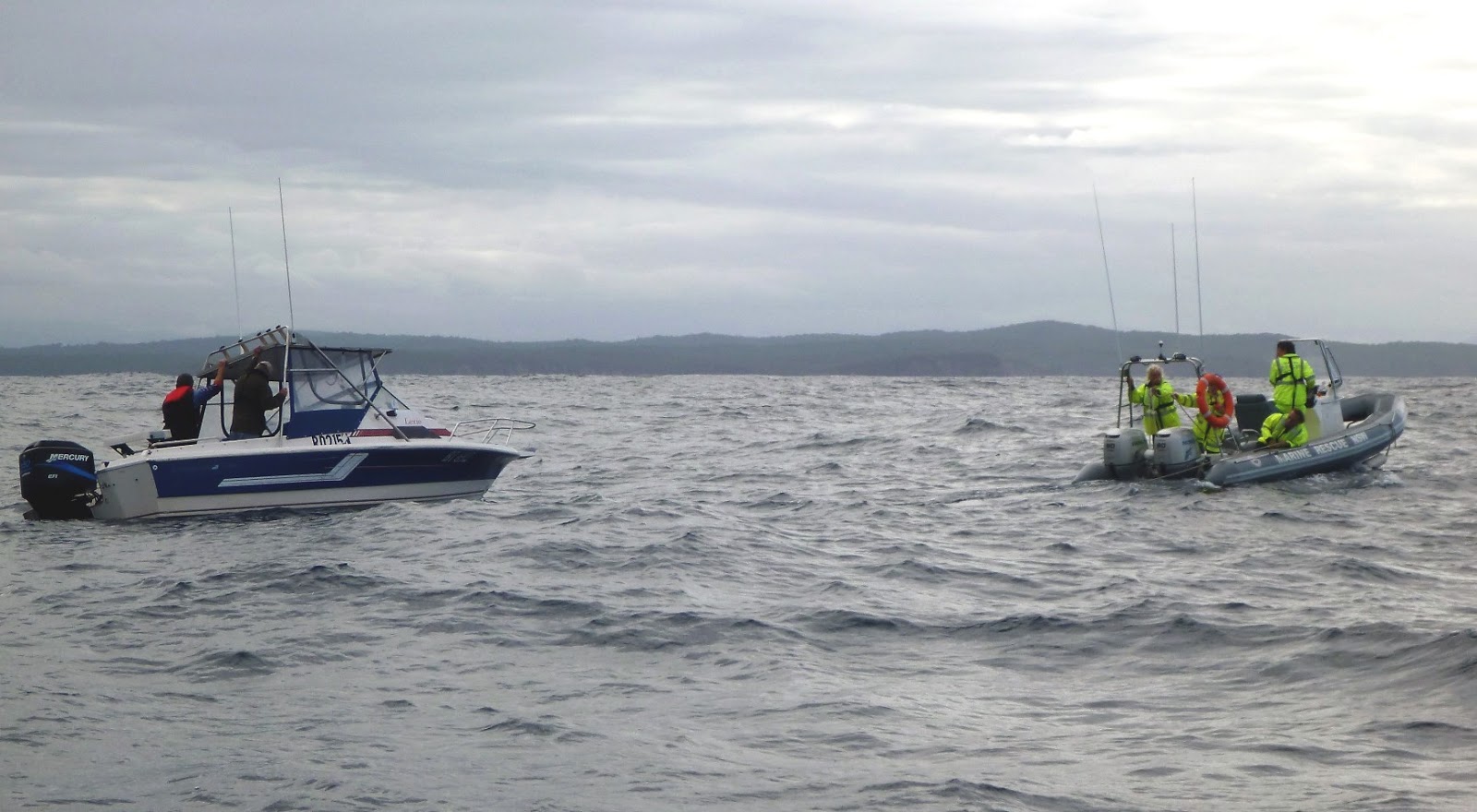
At our first call, Frank was ebullient, confirming that the Tollgate Islands plan was ON, all was in place and that he had a fish for us. Approaching Black Rock, just shy of the Tollgates, our radio again crackled to life. It was Frank, this time sounding not his upbeat self, and meekly advising that he was a couple of miles out to sea, with a flat battery and drifting with a motor that could not be started! He had called Marine Rescue Bateman’s Bay and help was on its way. We took directions and after steaming seaward for a time we eventually spotted the hapless fishers, wallowing in a sloppy sea, but like Mr Micawber, waiting for something to turn up. As we drew near, it was clear that coming alongside in this sea, without Frank’s manoeuvrability, was fraught with peril and things were bad enough as it was. As we slid alongside, but at a safe distance, Frank confirmed that apart from feeling crestfallen, they were and would be fine, and did not need a tow. Then Frank held up THE FISH! It was a glistening snapper, a catch of the day, more like a trophy than a catch. Frank, what a legend….now to get close enough to poke a boat hook across ….to manage the transfer. No champagne, to be sure, but think succulent snapper fillets, tossed salad, and minted potatoes. I was prepared to shun the Bull Sharks and swim across for a delectable offering like that. We failed to photograph the fish because our wide angle would not encompass it! At sea size does matter.


Rescue...Rescue.....Rescue
We were Frankly......disappointed!


And just then, just at that miserable moment, with a siren and flashing lights Marine Rescue arrived. No entreaties about old mates catching up carried any currency with these businesslike officials, and in a trice we were shooed away, Frank was taken in tow and our last image was of Frank holding his arms wide in appeal and totally defeated. So too were we. As we watched them go we turned the head of our ship again to the north, and set a new waypoint for a point off Ulludulla. Maybe, just maybe, later in the year we will get our chance to have Frank on board. By that time we will be able to re-tell the tale of the flat battery and the one that got away. Battery problems! They were haunting us even out at sea…..the cruel sea.


Sunset north of Bateman's Bay

By the time we reached our Ulludulla mark, darkness had fallen, and on this voyage of disappointments, there were two more to come. We had longed to detour to port beyond King George’s Head, and make our way into Jervis Bay where, in from Bowen Island,  lies the Hole in the Wall anchorage, one of New South Wales’ finest. We had fond hopes of overnighting there, and proceeding back out to sea in the shadow of the Point Perpendicular Cliffs, which viewed from out at sea are a truly remarkable natural feature. On our voyage of 2010, darkness had fallen when we were making north, and when heading south later in the year, yes it was day-time but the entire coast was blanketed in fog, and we stood well clear and proceeded away from the area with caution. One day we will see these magnificent cliffs as Cook, who named them, saw them, and no doubt we will be as impressed as he was in his time here. This time, in spite of the glorious full moon that had risen, and the cheeky wink of the Point Perpendicular light which seemed to taunt us, we passed on to the north, and when out from nearby Beecroft Head; the unmistakeable loom of lights from the Illawarra Coast became noticeable off our port bow.

There were other lights as well. At some distance out to starboard, carrying the lights of a city, but making next to no knots was the cruise ship, Pacific Aria. Our AIS confirmed her name and that in the new day she would get going for Sydney. In the wee hours though, she was a ship alight, but going nowhere. This was one of the cruises where the liner heads out to sea and without any particular destination, they return a day or two later. Give us a destination every time.
Calling Island Chief to avoid a collision !


Of more concern though was a bulk carrier, coming up rapidly from behind but with few of the luminescent adornments of the Aria. As the Island Chief closed on us, the AIS confirmed that with her destination of Port Kembla, she would cross our path, and on current heading, her CPA (closest point of approach) was a miniscule 0.01nm;a way, way too close for comfort. It was time to communicate with the Island Chief, so that we might pass each other in safety. At sea Channel 16 VHF is used for this purpose, and in no time the Officer of the Watch on the Chief came up in response to our call, and with great politeness and consideration offered to alter course to ensure that a one-mile separation between our ships was maintained as they slid by. It feels strange that an eight tonner like us would have the radio officer of a many thousand tonner like Island Chief  ask us “Calista, what would you like us to do”. We know that big ships appreciate little ships like us communicating in regards to safety at sea, especially if courtesies like referring to the officer as “sir” on call up are followed. We thanked them and continued on as the sky in the east turned peach, then apricot in the advance of the new day. It was Anzac Day and on board Calista, and via the national broadcaster we tuned into the dawn service from Canberra.  In the morning, on Calista we did remember the fallen. Lest we forget…..lest we forget.

....And in the morning....lest we forget.


Back at Port Elliot our Surf Club has a sister club relationship with Wollongong SLSC that dates from the 1950’5 and lasts to this day. Last year we travelled there for the centenary of lifesaving celebrations at our sister club. Now, picking a slalom course betwixt a raft of ships anchored in the area awaiting their turn to disgorge at Port Kembla, we spied the seascape of Wollongong via our glasses and scanned north as the coastal suburbs of Bulli, Corrimal, Coledale, Thirroul and Austinmer came into focus. A direct line to Port Hacking would have taken us well out to sea, but we had altered course to view these fondly held shores and to take a seaward look at the coastline of the Royal National Park that stretches north along the Illawarra coast to Port Hacking. When at Wollongong in February 2015, we returned to Sydney via the coast road, and like everyone who sees it for the first time, marvelled at the amazing Sea Cliff Bridge that curves out from the cliffs at Stanwell Park and has been the understandable focus for advertisements, travel shows, Sydney and Illawarra travel promos and the like. It truly is impressive and whilst travelling over it we longed to stop the car and get out for a bridge – eye look as it were.


Great view of the Sea Cliff Bridge from the sea


Alas this is not possible although one can view the bridge from afar at a viewing point a little up the coast. At the time, traversing the bridge and gazing from the lookout we wondered what this scene would look like from out at sea. Last time heading north off this coast we had awful conditions with rain squalls rising winds and darkness to contend with and we arrived off the Sydney coast bedraggled, sleep deprived and just wanting to get inside the heads. This time we had picked a calm and with a warm April sun it was a peach of a day to divert, and yes, to see the Sea Cliff Bridge as she was built, at our leisure from a sea perspective. It was worth committing this to our wish list because now the chance had come to convert this wish to a reality.


Yes, the Sea Cliff Bridge was remarkable from out at sea and yes to be able to putter along the coast as the coastline of the Royal National Park drew alongside was a pure delight. We commented on how Sydney, sprawling Sydney, benefits from being located alongside fabulous National Parks to the north, south and west and adds so much to the quality of the city. These are natural treasures that in another time were set aside and protected, from what we curiously call “development”. We hail those who with great foresight had these places preserved for all generations, and on behalf of the living things that call these parks home. There are lessons here aplenty for the decision makers of today. Maybe we need to take them on an excursion along the coastline of the Royal National Park on a day like we had, and they might draw conclusions about the value of conservation that, seem so abundantly clear to us.


Coalcliff  with the Royal National Park behind.


Wonderful wilderness coastline
Marley Beach

Beyond Marley Beach, a delightful nook that had drawn a host Anzac Day visitors, we could discern the headlands off Botany Bay and it was time to bring our wider thoughts back to the navigational reality of the present. Sliding along this pristine coastline, with our ship on autopilot, and us lying like iguanas out on the deck in the kindly autumnal sun, had been a moment to remember, and yes, as historic planes flew overhead from Nowra bound for the Anzac march in Sydney, we did not forget. We felt that the air crews of these magnificent machines were probably enjoying their coastal flyover as much as we were enjoying our time out at sea. What freedoms we enjoy…yes…lest we forget.


Headlands of Port Hacking then Botany Bay

Sydney is remarkable. You can go from wilderness to mayhem in a trice, and the suburb of Bundeena that backs upon the Royal National Park is a case in point. As we rounded Point Hacking, giving the Jibbon Bombora discreet space to port, the elite coastal suburb of Cronulla, Burraneer Point, Bonnie Vale and Lilli Pilli hove into view and with the expanse of Port Hacking unfolding one enters a different world. For one, the rise and fall of the ocean swell had gone. We called Marine Rescue Sydney to record the safe arrival of the yacht Calista in Port Hacking and thought back wistfully at signing off with Carol from American River VMR when we had arrived safely, say, at Emu Bay on Kangaroo Island. Carol and Emu Bay were an eternity away. Yes, Marine Rescue Sydney!

On approach to Jibbon Beach

Back at Bermagui, Keith had promoted Jibbon Beach, tucked away in the lee of Hacking Point as the place to head to drop our pick, to rest and regroup. There were courtesy moorings in this cove and with Bundeena at one end of the beach and the National Park at the other, this was quintessential Sydney. This was, however, a stellar day and we were not the only ones to be drawn to the delights of Jibbon Beach. With our arrival this made 20 boats, mostly sleek harbour craft that rarely feel an ocean swell, and with a casual glance it was clear that each vessel had arrived with larders brimming and eskies overflowing. So this was boating Sydney style. Wow, maybe we needed to adjust, from our oceanic behaviours to a latte land afloat.


Not such a remote and desolate place!


We longed to launch our duck and launch ourselves into the waters of Jibbon Beach, or maybe to take a stroll through the bush on one of the trails heading off into the park. Alas! Batteries! With us on anchor, the voltage in our batteries, egged on by our new solar panels spiralled to 14, 15 volts and beyond. Something was terribly wrong with our charge controlling system and no, it was not ok. If we left the boat with the batteries charging like a runaway train we ran the risk of both our batteries and our boat being cooked. Frank had no charge. We have too much. We are living the dream…..and going from port to port fixing out boat. We disconnected our charging system and slumped down in dismay. At least, with the sun setting, the other boats left as though on cue, and by the time we settled back in the cockpit with dip, biscuits, olives, sliced gherkins and tomatoes to review this quite extraordinary passage, it was time to reach into the ship’s fridge to raise a glass to our arrival on Sydney’s shores. Batteries are one thing, and yes we would have to devote even more time to this nagging problem. Today, though was Anzac Day, and as the sun set on Jibbon Beach, we were a solitary ship in a solitary cove, and all was well.

All the same, fresh baked snapper, salad and minted potatoes would have been nice….

Lest we forget.


Tuesday, April 26, 2016


Eden to Bermagui
10/4/16 to 24/4/16
( Blog readers please note - by left clicking on  photos you will see them full size and a photo gallery below. The same applies for previous blog posts..see blog archives below.)


Cookie has kept a daily diary of all our voyages, dating back to our first trips in Crystal Voyager in South Australia’s lower Lakes and Coorong. For us they are a joyous record of wonderful times afloat, and reading them, for us is to take a delightful and priceless trip back in time. A feature of her diaries is her “daily picture” where with her Derwent pencils in deft and creative mode she recreates her “image of the day”. She is a dab hand with the Derwents and from her diary this Blog is a by-product. She is often to be found in the cockpit, out at sea, immersed in a diary production. Her diary for 10/4/16 said simply “5.30 alarm sounded and we were galvanised (sort of!). Had a cuppa and were away by 6am”. Out at sea and making some 40 miles up the coast to Bermagui she would wryly remind me that “we are living the cruising dream, going from port to port, fixing our boat” Yes there were important things needing to be fixed aboard Calista.
The smoky haze over Eden at dawn


We had consigned two important boat related parcels to the Eden Post Office, but with this being the weekend and a forecast change on Monday making getting alongside the wharves problematical for a further day or two, Cookie’s creative mind came up with an obvious solution, head up the coast to Bermagui, one of our favourite places, from where we could somehow get back to Eden by road and in the meantime start the process of attending to our serious problem on board; the solar panels that were looking for all the world as though their effective life was at an end. Having effective solar panels to charge our batteries was vital to us, so fixing the problem when they were failing was vital too. In Bermagui we intended to attend to this problem, even if it meant delays in sourcing and installing new ones. This had to be done, and soon. The question was…where?


The coastal landscape north from Eden takes one past some of New South Wales’ coastal treasures, Merimbula, Tathra, Mimosa Rocks and the Mimosa National Park. We looked forward to supping on these vistas, but on this day the air was filled with smoke from controlled burns in the forests and it lay, languid and opaque over the scenery. We sailed when we could, motored when we could not sail, and eventually the unmistakeable sighting of the water tower atop the headland meant that Bermagui, beautiful Bermi, was nigh.
The familiar water tower and township of Bermi


We were last at Bermagui in December 2011 (see blog – calista10.blogspot.com), waiting for days on end for gales to clear from Gabo Island and eastern Bass Strait. Rounding the headland, the shapely lines of Horseshoe Bay, with the town nestling behind seemed much the same although on entering the channel to the harbour the new marina “fingers” that had added accommodation for additional 40 or so boats, was an immediate and welcome embellishment. We were fortunate that this was now in place, and it is already filled to near capacity. One berth remained however and we nestled into our Bermi home like a chihuahua between bull mastiffs, alongside a brace of multi storied sea palaces. These ghostly behemoths are a different species to our little ship and they make deep inroads into the fossil fuel resources of the planet every time they put to sea. Their names, too reflect their masculinity and status, hairy chested and autocratic. Dominator, Gladiator, Intimidator, Mascerator…..power with glory: palaces of gin.

The Chihuahua amongst  the Bull Mastiffs !


 Gordon, one of the local boat owners who co-manages the facility, was there to lend a hand with our lines. Ah, limited paperwork, maximum informality, totally friendly and typically Bermagui. A walk beyond the marina, and up into town confirmed that in timeless Bermagui little has changed, except that the little supermarket had been been consumed, as an eel gulps a minnow, by the new Woolies in town. Even here the good burghers of Bermi have held sway and demanded of the retailer that they could have their new supermarket, but its façade must reflect the character of the region, with forest timbers softening the inevitable concrete and glass. It has often galled us that our local supermarkets at Victor Harbor are bland replicas of other nondescript centres: from nameless suburbs; with no character, no soul, driven primarily by the bottom line.

Local contacts are worth more than Google, in places like Bermagui. In this case the lady at the Bermi Information Centre showed us the way when Google could not. “I think Rob at the Marina has a car that he hires out. Look I’ll give you his number…and no, you won’t find it online…it’s just a word of mouth thing…and yes….. the only other town with hire cars is Narooma and you’d need to catch a bus to get there…personally, I’d give Rob a call”. Easy. Everyone knows Rob and everyone knows that Rob is a good bloke.  Now we know that Rob is a good bloke as well, and a mover and shaker to boot, but more of R Grimstone later.

Rob’s car is a Pajero, and its thirst was that of a cameleer arriving at Birdsville. Our gratitude rivalled its consumption because not only were we soon on the road to Eden, but in answer to his question about how long we were staying and us relating our solar problems, his response was…”you should give Harley a ring…he does solar and electrical work in the marina and if you get on to him, remind him that I still want some things done at my place…but give him a call”.
The $25 a day wharf at Eden......much rather be at Bermi!


The hinterland to Eden, via the folksy town of Cobargo and the bigger berg of Bega, down the National Highway was, aesthetically, the poorer cousin of the forested coastline we had enjoyed from out at sea. At Bega, in spite of our keenness to make Eden, it seemed desirable to divert into the cheesery which we found to be dominated by its tearooms and an information centre. Here we liked the cheddars, but feeling overwhelmed and uneasy amidst the throng of tourists and tour buses, the excess of humanity soon had us heading south, to Eden.

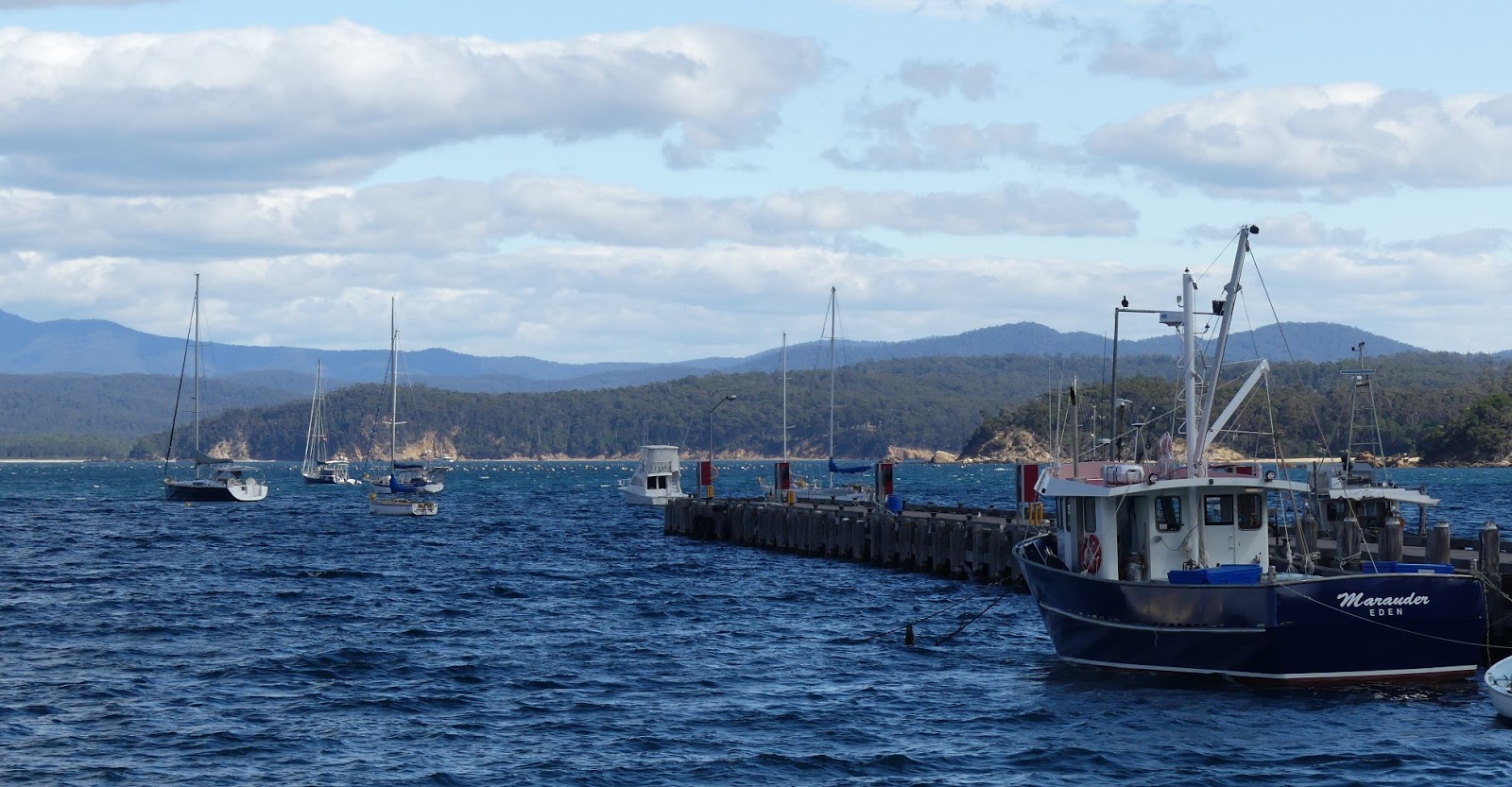
Reaching Eden by highway has convenience as its sole virtue, above that of arriving by sea. Its semi – industrial posterior along Highway One is no match for the approach from Green Cape into Twofold Bay.  The harbor is reached via the main street alongside the Museum dedicated to the last of the Killer Whales of Eden, Old Tom, whose symbiotic relationship with the local whalers has become the stuff of legend. Old Tom’s skull, complete with worn teeth from grappling harpoon lines has captivated young and old for generations. We passed on to the harbour, just as the predicted westerly kicked in, making conditions uncomfortable for any yacht wishing to come alongside for reprovisioning. Our enquires at the Harbor Office concerning moorings and tie-up locations were met with an air of taciturn disinterest and we were again thankful, that apart from the smoky passage, we were in Bermagui. Happily, though, the replacement head unit of our on-board entertainment system, which had failed early in this voyage, and a key device called an Optimiser, which will allow us to connect to the internet when beyond Telstra, were both waiting there for us at the Post Office.  One of the practical difficulties of being “at sea” is that we are often unsure where to send ongoing mail, given that our destinations can change, with circumstances sometimes beyond our control. In this case, a landing in Eden looked a safe bet until the weather intervened. People, who live their lives via regimentation, might be best to bypass life on a cruising yacht like ours.  
Tathra SLSC and beach viewed from the Jetty
Another beautiful beach on our south coast drive


Although the “Coastal Tourist Drive” north from Eden to Bermagui promised oceanic vistas, in truth its proximity to the sea was marginal at best. Merimbula and Pambula are ever popular, yet we found the coastal port of Tathra to have most appeal. Its jetty, a survivor from the era of coastal shipping, is impressive, although in recent years its story has been shrouded in melancholy and tragedy. In 2008, a 28 year old father plus his two young boys drowned there one evening when the boys fell in and the father drowned as well trying to help them, and in early April 2014 a senior female member of the local surf club was taken by a shark on a group swim to the wharf. Some of the swimmers saw the shark, but their close companion, Christine Armstrong, who had turned back to shore, had disappeared.  Her husband, Rob, was amongst the swimmers, and understandably, today, Tathra’s beauty is tinged with sadness, as the impact of these events drove deep into the feelings of this tight knit local community. We resolved that any swims along Bermagui’s Horseshoe Bay, would be undertaken as close as we could to shore.
Deceased solar panels

Back at Bermi, Harley the electrician visited to declare our Solar Panels terminally unwell and developed a plan to install new ones in a matter of days. Our hope of making for Bateman’s Bay then on to Jervis Bay while the weather held were dashed with Harley’s message that his supplier could not supply until sometime in May. We were back to square one, and having to re-ignite Cookie’s initial enquiries, that had been put on hold. Then came the challenge of accessing panels that would maximise the output that we could locate on our rear bimini, or “shelter”, but with an order in place a weekend passed by and we were left watching vessles, including Brian and Maree on Urchin, arrive and head north, like so many migrating Humpback Whales.
Home away from home... Horseshoe Bay Bermagui


We had to concede though, that if one was to be becalmed in a location for a while, you’d pick Bermagui every time. The marina is but a stroll from Bermi’s Horseshoe Bay, and the chance of a daily return swim across the bay became an event we longed for, with the water temperature hovering above 20 degrees being an added bonus. Swimming at Horseshoe Bay, had us feeling very much at a home away from home.
The Blue Pool


It was easy to be tempted into town for a stroll, a browse, a baked offering, or for no particular reason at all. Beyond the town centre and over the headland is found Bermi’s beautiful Blue Pool, where a swim in this sea pool is to swim with an aquarium of fish, and even an inquisitive octopus. Extending beyond the town are coastal walks of differing degrees of difficulty, and we were grateful that Cookie’s bung knee was now less bung, following a pre-voyage arthroscopy, and that her nimble self was increasingly in evidence. Whilst lots of cruising folk may embrace the option to lounge whilst in port, we have always sought to exercise our option to exercise, and if possible to include the local environment in the process.
Downtown Bermagui


One weekend saw Bermagui come alive with the throb and roar of a thousand bikes as the town played host to the Sixth Annual Bermagui Bike Rally, a bikers extravaganza, aimed at allowing two-wheeled mates a chance to convivialise – and to mount a take-over of the Bermi Hotel; or so it seemed. Rob Grimstone was at the helm of this event which was more than a Triumph, it was BMW, Harley and Indian, too. There were rock bands, displays, and memorabilia, and apart from the mateship that was impossible to miss, there was an underlying purpose to it all. A few years ago Rob’s mum became a victim of cancer and Rob, being the bloke that he is, resolved to do something about this, if not for his mum, then maybe for others. The Rally raises money for cancer research, and when the two wheel exodus rolled out at rally’s end, this noble cause was nearly $40,000 better off. What was also off was Rob’s signature beard, all for a good cause, and nearly a thousand dollars in the kitty for the unveiling. Onya, Rob.
The older we get the better we was!


The marina, like Port Fairy’s Moyne River has its resident stingrays, immense in size, and one or two of them, plus a host of fry, were regularly sighted, as well, on our daily swims. A fever of stingrays and a pod of pelicans – yes these collective nouns are correct – would gather like clockwork with the arrival of recreational fishers at the marina fish processing area. The pelicans are well fed and correspondingly tame while the rays gather in the water by the boat ramp like Labrador pups at a Sunday barbecue. Like the rays of Port Fairy, it was hard to put forward a compelling case, as to why they should ever leave the harbour and put to sea. They would regularly glide past the fish’n chip café and other eateries at the Bermagui Fisherman’s Cooperative much to the astonishment of tourists who were not expecting to spy such a denizen of the deep at close quarters.


Bermagui has long been associated with big game fishing and a fine weekend day typically sees an exodus of boats making for the marlin. These days a catch and release policy seems to be closely followed, but the possibility of fighting a fine fish brings tight-line heroes from near and far. It is evident that catching bill-fish can be more than just fishing, but a prominent driver of life. I fish to live and I live to fish… One screaming reel devotee at Bermi obviously had his piscatorial passion conflict with other supposedly important things in life. His boat, polished and gleaming for the fray, was called ….wait for this…..She Left. We were not sure whether to laugh or cry. No doubt he continued fishing after she left.


Our Bermi evenings were eased by the proximity of the Co-Op, where with commercial fishing boats disgorging their catches on the wharf for the Sydney Fish Market, there was always a selection of fresh fillets to be had at their fish shop, primed for the griddle on Calista. Apart from the local pub, we enjoyed two stellar nights at the little, but fabulous River Rock Café. We don’t think that Friday nights at the River Rock are advertised because you have to be lucky to get in at the best of times. We had the River Rock recommended to us when we were confined to port in 2010, and one of our first questions to locals this time was “does the River Rock still do Friday nights?”. You bet, but you’d better book, was advice from the top shelf. The River Rock specialises in Mexican cuisine but we were not drawn there in any special degree for the nachos and the enchiladas, or for the BYO that went with it. Matt and Jackie are mine hosts at the RR, and when not providing mex-cellent dishes, are both musos of considerable note.

The RR is only open on Friday nights and features an “open mike” showcase of local talent, both skilled and in the making.  With everyone noshing and chatting, Jackie normally kicks off the entertainment by climbing onto the piano where her command of the sharps and flats and her resonant voice soon has her squeezing life out of popular covers and some offerings of her own. Then, as if by magic, others emerge from the crowd with their instruments and the River Rock gets rocking. The venue attracts talent from near and far, and unless one is insufferably dull, a great night out is guaranteed. For us being total strangers, to be welcomed and included as we were has us knowing why people love living in Bermagui.
Local Musos ! One of them had too many reds!


Back on board, though, a solution to our solar panel woes was as hard to reach as a hip pocket in a singlet. Yes, we had new light weight panels installed that put out plenty of energy, but somewhere between the charge controllers and our battery bank we had loads of electrons doing their own thing, just like the musos at the River Rock. New, high quality controllers were not playing fair and the batteries took on voltages that would have made them, and us boil. Getting answers to this all-encompassing problem was proving a nightmare, and as our frustration grew, so the days drifted by.
Exploring the Bermagui River on our kayaks


Eventually, it was the weather that called a halt to our anguish. Our original plan to call in to the Bateman’s Bay and Jervis Bay areas disappeared alongside unscheduled days in port. With a window of fair weather approaching, and with days of unkind northerlies beyond, we resolved to pack away our tools, and make overnight for Port Hacking, just south of Sydney. There with some fresh advice and renewed hope supplied by Keith, the co-manager of the Bermi Marina, we readied to go. Keith’s professional background was in electrical engineering and his arrival on the scene was akin to the cavalry saving the day on an aged western. At least we were leaving with hope and a plan. First, though, it was time to bid farewell to beautiful Bermagui, and as the strong winds from a passing cold front headed to the north, we would follow in its wake. The moon was nearly full and there is little to compare with night sailing out at sea, with the soft light of the lunar orb showing the way.


Sunset ..Bermagui River

Sunday, April 10, 2016


Launceston to Eden
7/4/16 – 9/4/16

The BOM Bass Strait weather bulletins said it all. Above the daily wind wave and swell forecasts for the areas through which we were planning to sail, under Weather Situation, is found a description of the main weather features impacting a region. The advance of a “vigorous cold front”, for example, would see one heading for refuge or staying in port until it passed. The Weather Situation notes had been daunting, pointing to a large area of low pressure off the Antarctic coast (!!) that had spawned a series of cold fronts, to impact Tasmanian waters; a bit like a Mafia Boss sending off his goons to rough up those not paying their dues. Also in marine forecasts is found the disclaimer that “wind gusts may be up to 40 per cent stronger than the averages given here, and waves may be up to twice the height’. Those who know Bass Strait think that this disclaimer was born in these waters.

We use a number of BOM tools to guide our passages at sea. They include Marine Wind, MetEye, Interactive Weather and Wave Forecast Maps (for a 7-day isobar pattern analysis) , the specific 3-day area forecasts as above, and a valuable tool called Coastal Observations, that gives up to the minute wind readings for key coastal locations around the Australian coastline. Safely anchored in the Tamar, for example, we could watch a system pass through and see the winds that were actually generated out at sea, in places including: King Island, Hogan Island (middle of Bass Strait), Flinders Island, Gabo Island off the Victorian / NSW border, Low Head, at the head of the Tamar, and our notorious friend, Cape Grim, on Tasmania’s remote NW coast. Watching wind readings at Hogan Island, with the passage of a front makes for sobering viewing for small vessel operators like us.
Marine Wind

Interactive weather chart

Then, out of the grey, not blue, an opportunity emerged. Between two systems a dedicated westerly was predicted for Bass Strait that should allow us to leave the Tamar “on the back” of one system, ride it for two days, and then sneak around Gabo Island and up the southern coast of NSW to Eden before the next burst from the Southern Ocean. That was the theory, anyway. So, we readied Calista to go and slept on it, or rather slept lightly on it because out in the strait at Hogan Island, on the eve of departure, winds were still gusting to gale in ferocity. The forecast was for the winds to settle, so, having to wait until mid-morning to manage the tide, we would have the chance to double and triple check the observations before we put to sea.

So after farewelling Lionel and casting a longing look at the Lady Buick, we made our way out into the Tamar, and then on to Low Head and the open sea. We were not the only ones making for Bass Strait, as just behind us a big ship was heading out from Bell Bay, and making for the Eastern States. We wondered if their crew sweated on the morning forecasts as we had!

Farewell Low Head & the Tamar River

There is nothing like wind and swell to remind one that you are at sea. True to the forecast though, the westerly was in, giving us a chance to set a friendly sail pattern, one that gave us good boat speed without being overpowered. The “balance” is felt through the helm, and if the helm is hard to manage, then the sails need adjusting. We found that a reefed main and about a ¾ headsail gave us a good “feel” at the wheel and allowed us to engage our Fleming Wind vane, to steer us on a prescribed course whilst we sheltered in the cockpit. If the wind held from the west, and the Fleming (we call the vane “Kev” after Port Lincoln’s Kevin Fleming, the marine genius who invented this self-steering marvel) did its work, we should be free of duties on the wheel as we set up our “watches”. There were other benefits as well, as out to sea the top-sea was unfriendly in the wake of the recent weather, and with thumping regularity a wave hit our side and anyone at the wheel would have scored a drenching. Moving around, and making or getting things from below was not easy, and protracted activities below such as fixing a plot on the paper chart  could bring on that feeling of feeling “odd”. For the record, whilst we have both been seasick before, and know that this is an awful affliction, we have not been ill on board our ship, and whenever we feel “off” we take, as recommended by a sailor we met at Bustard Head in Queensland, an off the shelf medication called Avil. So far Avil seems to work for us, and may it continue to do so.

Go Kev!

With the coast of Tasmania disappearing as though it was punctured and losing air, and with the boat sailing nicely, there was little scope for complacency because there were dangers laying ahead. Our original plan was to sail from the Tamar to the Furneaux Group of islands off Tasmania’s NE coast, of which Flinders and Cape Barren islands are clearly the largest, with a range of potential anchorages to boot. The vagaries of the weather however did not permit this although sailors with local knowledge might have gone there anyway. Further out lay the more desirable Deal Island in the Kent Group, which is manned by volunteers on behalf of Victorian Parks. We might have headed there but, in theory, one needs permission from the Victorian authorities to go ashore. Given the brevity of the weather window we resolved to pass between Flinders and Deal islands, before bearing away to the eastern end of Bass Strait. This path however left us with the task of negotiating our way between the scattered islands and rocks that dot this region, and to do so at night.
Great to be sailing!

With a greater reliance on electronic charts in this era of technology linked to voyaging, it would be easy to make piloting errors on the electronic chart and imperil both ship and crew in the process. The speediest way north of Flinders Island, for instance leaves one exposed to the danger of hitting Frankland Rock which would lie directly on this path. On the electronic chart, this nasty obstacle appears on some scales but not on others, but we were mindful of it because it is apparent on the paper chart, and looked for it on the electronic version. Because we were cautious about currents that beset the coast of Flinders Island we selected a passage a little further out to sea, leaving Warrego Rock to starboard, Bass Pyramid and Wakitipu Rock to port, before dodging between Beagle Rock and Craggy Island, in the early hours of the new day. Craggy Island, at least, is lit and this would give us some form of reassuring confirmation that we were where we were supposed to be, as we passed by. Besides, with our pattern of two-hour watches in place, Cookie would have to manage the piloting between Beagle and Craggy before we were free of the islands and making for the open waters of Eastern Bass Strait. I would be asleep, below.

With the dawn, and with the faint outline of Flinders Island and Outer Sister islands away to starboard, the westerly had softened, the sea had settled and there was evidence aplenty that the selection of this passage was working in our favour. Because we were remote from the services of either Tasmanian or Victorian VHF Marine Rescue services, we had instigated a daily connection with VMC Radio Charleville via HF Radio to report our position, status and progress, just to ensure that an official body knew of our passage and were monitoring our progress. We plan to have a daily contact or sked when crossing the Tasman and to us crossing Bass Strait was a good time to test this service and our HF equipment.  As the day progressed, however, there was a growing need to be alert to the presence of big ships, making their way both east and west through Bass Strait, tracking around the restricted areas of the Oil and Gas fields. As the airs softened, our apparent wind reading (if the wind is behind us at 10 knots, and we are travelling at 5 knots the ‘apparent’ wind is 5 knots over our deck) fell and “Kev”, lost interest in steering our ship. By late afternoon we had squeezed all we could out of the breeze and as Cookie’s fine veggie pastas slid into our oven we engaged the motor plus the wheel autopilot and settled in to our second night at sea.
Traffic at sunset

Just when we wanted the wheel autopilot to work like a charm, it failed. This left me steering whist Cookie headed for the Pilot Manual, and soon diagnosed the problem as a slipping drive belt. With manual in one hand and allen key in the other, the belt was adjusted – how it had come loose we will never know – and piloting machinery and motor were again in equilibrium, along with the crew. Our course through the night was to the inside of the New Zealand Star Bank, a rocky shelf that according to the chart “breaks in heavy weather”. We have no desire at all to see the New Zealand Star Bank in its foaming fury, unless it is from the deck of a ship that is far greater than 36’ in length.

The 2am to 4am watch can be harsh, but with big ships around and the loom of fishing boats with their bright lights over the horizon there were things aplenty to occupy one’s mind. On this watch, though, I was scouring the horizon off our port bow until, there, faint at first, it was. Point Hicks was the first land spotted on the Australian coast by the crew of Cook’s Endeavour, in 1770. Here, 246 years later, it was not the good Midshipman Hicks, but a crewmember of Calista to record the sighting. The Lighthouse at Point Hicks flashes twice in 10 seconds, and there it was, where it should have been, with us set to see the coast of the mainland at dawn, off Rame and Little Rame Heads in the new day.
Welcome dawn
Great to be passing Gabo

There is a sense of relief we think, for all seafarers in small boats when Gabo Island draws alongside and Bass Strait is left astern. The gales that this sturdy pinnacle and its clutch of keeper’s cottages have endured over time defy contemplation. What it must have been like in the tower during a fully- fledged tempest can only be imagined. Ahead, as the bow is turned to the north, lay the windswept dunes of Cape Howe and the regal Lighthouse at Green Cape before the famous sea port of Twofold Bay emerged from the haze. The southern coast of New South Wales is a delight to behold, and especially from out at sea where the vistas are uniquely the province of sea-voyagers like ourselves. Unlike in South Australia, where, the business of growing crops led to whole scale land clearance, and an arboreally challenged landscape, the dappled forests of the NSW coast flow down to caress the capes, garnish the hinterlands and bedeck the bays. Much of the coast remains as Midshipman Hicks, his famous Captain and the great botanist, Sir Joseph Banks, would have seen it all those years ago. May it long remain so.
Entering the anchorage at East Ben Boyd Bay


Rounding up into Twofold Bay, the town and port of Eden became clear away to starboard, but we made to port where behind the wood chip loading facility, in the sheltered waters of East Boyd Bay, our anchor rattled out into excellent holding in sand. Here one might sit out a southerly gale with impunity. Our voyage from Launceston, some 308 miles at sea, had taken a touch under 55 hours. As a masaman coconut curry issued its enticing vapours from below we drew a celebratory draft from the ship’s fridge and watched the Pacific Basin as it loaded logs from local forests for lands far away. After the lonely hours out at sea to hear the clanking banging and grinding as trucks laden with logs arrived to disgorge their loads might have been an odious comparison.  This cacophony continued on through the night, but it would take more than this discordant din to keep us from sleeping.

Cheers! We made it safely across Bass Strait!

Neighbours

The truth was, however, there was something else on our minds that had been causing us unease, a problem on board that urgently needed attention. Seeking a solution to it might mean us not lingering to enjoy the attractions of Eden and Twofold Bay. It, plus the forecast of some obtuse weather on the way, had us doing the last thing that was on our mind, the setting of an early alarm to head north, out to sea and away from Twofold Bay.