Wednesday, April 6, 2016

Launceston / Tasmania


31/1/16 – 7/4/16


On board Calista we seem to live by maps, charts and the like, so it is a shameful admission that snugged securely in at the Beauty Point Marina in the Tamar, we had not really appreciated that instead of Launceston being “just down the road”, in reality it was about 50 km away, making a bus trip into town into an expedition, and leaving us, in a sense, marooned. A check of the weather patterns suggested that a series of fronts would impact Tasmanian waters, either fleetingly or significantly, so we would be in Beauty Point for a few days at least. With this in mind we started to look at options beyond the marina compound and consider some possibilities.

Misty sun rise at Beauty Point Marina


In truth Cookie was already on to it. A hire car, a cheapie if we could find one, would fit the bill, just nicely, and might give us a chance to see a bit of Tassie while we were in port, certainly more than we could experience from the marina. In a trice, armed with the local bus timetable, and armed with the results of her vehicular sleuthing, she was off on the omnibus, trundling into “Lonnie” as the locals refer to their city on the Tamar. I mused about what she would re-emerge with, because in terms of putting our show on the road, Cookie is the ultimate wheeler dealer.

In the meantime I had some personal nostalgia to attract my attention. In the 1950’s the remote and rugged South Coast of SA’s Kangaroo Island was a last frontier for fishermen, as they were called before the correctness of politics.. My mother was Dorothy (Dolly) Buick, from the pioneering KI Buick family, and my uncle Nigel, had plans to go cray and shark fishing beyond Cape Willoughby, in his 42foot boat Emu Bay. Our family ran a seasonal Guest House, Maryland at Port Elliot, and my father Joe, being a seafarer to his core, was persuaded to join Nigel to head south of the island. Dad fished with Nigel for some years, before returning home to full time employment, and Nigel continued on to become a leading figure in the KI fishing industry, as a fisher and fish processor for diverse local and overseas markets. Nigel was truly one of SA’s fishing pioneers.
Lady Buick


In the late 1960’s Nigel embarked on the ambitious project of constructing, at Port Adelaide, the grand Lady Buick, which, when launched, became the undisputed queen of the KI fishing fleet. Later, Nigel’s retirement from fishing saw the Lady Buick sold and sadly move out of SA waters. Now, to my great surprise, as we eased into Beauty Point, there she lay, the Lady Buick, in new livery and looking as grand as ever. Although now for sale, she was still at work in the crayfish industry, with her heavy wooden frame having withstood decades at sea, and looking good for many more sea miles to come. When we had left Backstairs Passage and with Cape Willoughby astern of us I had cast a long look down the KI coast to Cape Hart and beyond and thought of Nigel, dad, the old Emu Bay and the Lady Buick. Dad would have loved what we are now doing on Calista.  About that there is no doubt. Now here she was at Beauty Point, the Lady Buick, having stood the test of time as Nigel had always intended that she would. It was wonderful to see her and to go aboard once more.

My thoughts of other times were put aside, when, with a flash of white, if not a scattering of gravel, Biggles was back. Cookie had scooped the pool. She was stepping out of an incredibly svelte VW Polo, complete with more bells and whistles than any car we had ever driven, and all for a smidgin’ over $200, if we wanted it for a week. “You could drive it to Mars on a cup of cooking oil” was the message. Cookie the wheeler dealer! Now we could lift our eyes to the horizon, and Tasmania was at our mercy, provided we could bear the parting from our vessel for a couple of sunsets.


On the ship’s table we lay out the map of Tassie and realised that we were only a couple of hours down the highway from Hobart, where we could call in and see our ex SA friends, Craig and Margie off Force Majeure, take a look at their fine new home overlooking Storm Bay, check out the marine possibilities in the D’entrecasteaux Channel area south of Hobart, and take a whistle-stop whip around the East coast on our way back to Launceston. Wow. This would give us a chance to connect with some fine friends, and gain some appreciation of some places in Tasmania that were on our “list to see” when we headed for southern Tassie waters, hopefully, in the longer days of the summer coming. Neither of us could claim any personal knowledge of the Apple Isle apart from our appreciation of its unsurpassed wilderness areas, its stunning coastline and its ever challenging weather. We have a fondness for capturing the possibilities of the unplanned moment. How long did it take to call Margie, throw some things in a portmanteau, and hit the road? If this was an event at Rio, we would have medalled.
Our new friend Lionel


On our way out we called in to see caretaker Lionel about our plans, and he shuffled, with something on his mind. He confessed that we’d be seeing more of Tassie than he has in his lifetime. Then in a lowered, conspiratorial tone, he admitted that he avoids “going south”. “There’s northern Tasmania and southern Tasmania, you see, and we don’t always see eye to eye” was his confession to us both. Yes, they make Cascade beer in Hobart and you won’t find it “on tap” up north.  They make Boag’s beer in Launceston and you won’t find it “on tap” down south – for reasons best known to Tasmanians. Blame isolation in another era. Blame human nature. Blame too many hard winters.

At one time in our lives we found it hard bypass a surf shop, and now we are the same with marine chandleries.  Being fond of chandleries is an expensive habit but we are impossibly fallible in this regard. In our incredibly sprightly Polo we were southbound on a mission but still found time to be tantalised by the offerings at Tamar Marine, on the outskirts of Launceston, and one of the finest chandleries we have seen, anywhere. It is fortunate that we were shy of time because a longer stay might have seen us putting an urgent call to our fund manager!

Not far out of “Lonnie” we came to a curious halt. A large number of people dressed in the livery of motor companies but apparently not being paid to do so, had gathered in a paddock that now had sprouted tents and a grandstand for what the official informed us was a V8 Supercar event. The attendees in their red and blue uniforms were apparently there to watch cars drive around for two days .With not a Polo in sight we figured that we were out of our depth and should keep heading south.

About half way to Hobart we passed through Campell Town. We wondered if there was a pub there that had both Cascade and Boag’s on tap, but did not stop to see. A couple of aged towns and historic bridges later the looming shadow of Mt Wellington assured us that Hobart Town was indeed not far away.

Constitution Dock Hobart


There are many things that one can and maybe should do, or see in Hobart, but we were focussed on just two. How many times had we seen footage of the finish of the Sydney Hobart Yacht race, when the steeds of the sea finally extinguished their sails and with fanfare to match eased up to Constitution Dock? We wanted to go to Constitution Dock, just to see it for ourselves, albeit minus the spraying beer and the volleys of champagne corks. Strolling along the gnarled and famous pier we had to pinch ourselves, as not only were we actually here, but the day was a clinker and the good folk of Hobart plus a legion of visitors were celebrating the warmth of the autumnal sun, and had retrieved shorts and t-shirts from deep in cupboards to celebrate.


View from Mt wellington before it disappeared !

Overhead, though, Mount Wellington both loomed and beckoned. We wanted to head to its lofty summit from where one can literally see for miles and miles, way out to the rugged Tasman Peninsula and almost to lands where you can find Boag’s on tap. Compared with The Nut at Stanley, our ascent of Mt Wellington was both soft and luxurious, as thanks to some astute engineering in the 1930’s, we could now drive up, up, and up some more all the way to the top. We have a healthy respect for the changeability of Tasmanian weather, and maybe the Weather Gods, were keen to send a message to us, underlined, bold and in italics. No sooner had we alighted from our fatherland conveyance, than a rolling and ominous curtain of clouds threatened the peak from the west and, sensing its malevolent intent, sought immediate shelter. From a hardy glass conservatory, the view that we had so eagerly sought was lost; in cloud, then rain, then hail, then sleet…then…snow!!! Yes, cotton wool flurries scattering in the wind and scattering the tourists. The temperature had plunged to 2degrees C atop the mountain. We have received the message about Tasmanian weather. Yes, we have taken serious note.

Later at Craig and Margie’s, just a half an hour away. We looked back at the summit and all was clear in the afternoon sun. We could feel the mountain mocking us, warning us maybe. Come and visit, but be warned! Don’t take Tasmania for granted.
Wonderful view from Craig & Margie's house

Blackmans Bay from Craig & Margie's balcony

Craig assured that owing to the topography of Hobart shores, many Taswegians enjoyed a spectacular view like the one they now enjoyed. All the same, their picture perfect panorama across Storm Bay and the fabled Iron Pot to the Tasman Peninsula more than made up for what had disappeared into the clouds up on Mount Wellington. Then as we noshed over some succulent home grown curries, Margie announced that, if we placed ourselves in their hands, a tour on the morrow to the waterways abeam of Bruny Island, including the magnificent D’entrecasteaux Channel, the port of Kettering and much, much more might be a fine way to fill in a Sunday. Indeed! Indeed!

We will let our images from this stellar day tell its story, except to add there were two circumstances from back in SA waters that we found in the superb harbour of Kettering. First, was that we got to see Sara 2 , the fine Duncanson 35 yacht, that Craig and Margie had spruced for sale with the arrival of Force Majeure. Sara 2 was looking a treat and would make a worthy purchase for anyone keen on embarking on a cruising life. We had shared some fine times on Sara 2 and Calista, especially in Port Lincoln waters, and it was great to see Sara 2 again. May she find some new owners just like Craig and Margie.
Great to see Ray again!

Serendipity, serendipity of the sea! Deny it at your peril. There, to our astonishment was an old friend from another time, Ray Snook, afloat on his boat, next to Sara 2 right there in Kettering. We had known Ray when we first took our 26’ trailerable yacht Crystal Voyager to the blue water at Wirrina from the brown of Goolwa. We tried at the time to reassure Ray that, with care, he could sail the seas. Well, he did, and here he was, here in far off Kettering. Seeing Ray again was a highlight in a day that had too many highlights to calculate.

Here are some images from our Sunday, south of Hobart.


Our day starts with a swim at Blackmans Bay

One of the numerous wonderful anchorages in the D'entrecasteaux Channel, Charlotte Bay


Endless rustic charm

Cygnet

Franklin on the Huon River,home of wooden boatbuilding

A coffee at Mt Nelson lookout with Craig & Margie at the end of our tour


Next day as Craig and Margie headed to their new places of employ, and with our grateful thanks for their kind hospitality, we hit the road. Our goal was to see as many anchorages and places of marine interest as we could, up the East Coast of Tasmania before sunset. If we could, we’d try and squeeze in a lap through the Tasman Peninsula, and then on up to Triabunna, Swansea, Bicheno and on up to St Helens, taking in the Freycinet Peninsula and Maria island just for good measure. We doubt that a barnstorming US politician could have kissed more babies and licked more ice creams than the coves, embayments, marinas, wharves, jetties, headlands and islands that we saw that day. Making St Helens just on nightfall, and securing some modest accommodation for the night capped a day with many images. Here is a selection…

Dunalley
The Dunalley Channel
Ocean side view from Eaglehawk Neck

Inland waterway view at Eaglehawk Neck

The Freycinet Peninsula
Modest accommodation but nice view ( & nice car ) over the harbour at St Helens


The new day presented us with the opportunity to see a little of the hugely popular Bay of Fires coastal area, north of St Helens before we literally headed for the hills. The main drag over the ranges through to Scottsdale and to Bridport on the NE coast takes in a slice of Tasmania’s extraordinarily beautiful temperate forest country. It is not possible, in our view, to emerge from these dappled and exquisite forest glades without a conviction that these special places are national treasures that must be preserved. Surely their staggering natural beauty must place them beyond the needs and the grasp of us humans. Surely.


Bay of Fires


From the sea to the forests

Beyond the town of George Town, which did little, we admit, to quicken our pulses, we found the fascinating Low Head Light station and Pilot facility, steeped in history and thankfully well preserved for all to enjoy. The Pilot and Light Keepers quarters can now be rented, much as some of the facilities at some light houses in SA. On another occasion it would be fascinating to take digs out at Low Head, maybe in the depths of winter with a blazing fire warming the cockles of the heart.


Low Head Lighthouse

Seeing Low head, and remembering our passage into the Tamar just days earlier, was a salient reminder that it was time to get back to our ship, and think carefully about our next passage, back out of the Tamar and across Bass Strait to Eden in New South Wales. This was a voyage that would require us to be on our mettle in guiding Calista through these complex waters. The first thing was to identify a window of weather that would allow us to complete a safe crossing of this notorious waterway. Then, we would embark on two days and nights at sea, with no moon to light our way. Enough, maybe, to give anyone the Hebe jeebies!

.

Wednesday, March 30, 2016


King Island to Launceston 
28/3/16 – 31/3/16

Sliding out of Grassy Harbour presented few of the hurdles that we had faced on the way in. There were no rain squalls to impair our visibility, and although cloudy, the wind had softened and we had soon retraced our steps to the open sea. A warming coffee and two of Cookie’s peerless cheese and tomato jaffles, hot from the galley, had fortified us before we slipped from the security of Bear’s mooring.
Passing Frog Rock on our way out of Grassy Harbour

As King Island receded in our wake, our early hopes of a lively sail across the 47nm passage to Three Hummock Island were foiled by the light airs close to the coast, before in waters open to the pulse of the Southern Ocean we sensed the winds lift along with the swell. We were galvanised into activity as now it was time to unfurl our equipment and show how Calista could carve through the billows. If you could book an optimum sailing breeze, like the fabled porridge, not too much of one, too little of another, then this was it. Too good was this to be left in the hands of mechanical devices: it was a case of the crew scrambling for a “turn” at the wheel, with cool wind in our hair, and bumps rising on the horizon that became Hummocks as the day progressed. We had waited for a passage like this.
On approach to Three Hummocks

Our early plan was to make for the spacious and sandy anchorage of East Telegraph Bay, but Mary’s forecast update had a light southerly setting in overnight, so we settled on the Mermaid Bay anchorage on the northern coast of Three Hummock Island. As we drew near there were unmistakeable similarities between the coastline of Three Hummocks and that of the Jessieu Peninsula, stretching from Cape Donnington to Memory Cove out from Port Lincoln. Our ground tackle rattled out into excellent holding in the bay, and with shadows lengthening, we opted to enjoy the delights of this place from our cockpit vantage point, rather than marshal a hasty trip ashore. As the day became evening we had hoped for the beam of the Cape Rochon Light on the nearby headland to illume the gloom, but its beam is directional and we could detect no trace of it from the snugness of our anchorage. Into the evening and throughout the night Fairy Penguins pierced the air with their discordant carolling, and we wondered when they ever slept. Here there are many Fairy Penguins and few seals. At home there are now many seals and now few penguins. The lament about our disappearing penguin populations at home is explained by what we have observed here. We have joined the dots.

Securely anchored in Mermaid Bay

Again the redoubtable Mary’s weather report confirmed most of what we feared was about to unfold, along the North-West Coast of Tassie. The infamous Cape Grim where the wind always howls lay only miles away and approaching weather from the Southern Ocean would mean that for seafarers new to the area, it would be prudent to make for a secure mainland port before conditions collapsed. The good thing though, was that if we were nimble, we could fit in a whistle-stop visit to the historic port of old Stanley town before making for the security of the Beauty Point Marina on Launceston’s Tamar River ahead of the change to come.  All of this meant that a land exploration of Three Hummocks would have to be shelved, if we were to make it to Stanley in time to sup on its renowned delights. This meant, too, an early get-up and a hasty gulp of cereals instead of the preferred jaffles, before putting to sea.
Leaving Mermaid Bay

With Cape Rochon rounded, we set to sea into a wind that was niggardly of direction and a sea state confused by an ebbing tide. The currents around Hunter and Three Hummock Islands are well known for their contrary nature, and it seemed to us that on this morning the currents were every bit contrary as though they were issuing a cautionary message to visitors like us. What was clear however was that we would not need to deploy our arsenal of electronic equipment to find the port of Stanley on the map. The town huddles in the shadow of a long extinct volcanic plug, called “The Nut”, which is clearly visible for miles and miles away. There, to be sure was The Nut, like an inverted bowler hat, prominent and unmistakeable, off our bow, even though it was over 30 miles away. What we needed to do was to proceed with as much haste as we could muster so that we could tether in the harbour and see if a scaling of The Nut, plus a lap of the town could be achieved in daylight hours.

On approach to the Nut and Stanley
The Nut

Unfortunately, coming into the Stanley Harbour, carries with it some unique challenges of its own, which were likely to run contrary to our desire to tie up and quickly head into town. The harbour, cosy in nature, comes with a pinch of the random as a visiting yacht cannot see where a tie up to the wharf might be possible until actually in the harbour. This means that setting up mooring lines, either on the port or starboard side of the ship, might not suit what is on offer there. In addition, Stanley has significant tidal variation of at least three metres, so that mooring lines when in place need to be of sufficient length to accommodate all points of the tide. Then, because a tie-up to jetty piles is mandatory, a barge board to protect a vessel from abrasion is a standard requirement in this harbour. Whilst all this took precious time to manage when we arrived, tying up in Stanley was free, and there were good folk ashore happy to help with our lines.
Entering Stanley harbour & safely secured to the wharf


With the day in decline and Calista secure, we set about a Stanley reconnoitre, including an attempt on The Nut, minus crampons, ropes, and oxygen. After what had been, we will admit, a hurried passage and a convoluted arrivals process, we were off into town. Immediately we dropped back through some gears, captured by the unhurried pace of this historic and homely outpost.

Charming historic Stanley


There is more than a pinch of the frontier about Stanley, being as approximate as it is to Tasmania’s wild, Wild West. Care has been taken to preserve the character of the town and the streetscapes are a delight to behold. Stay away from Stanley if the modern world of pre-fab and glass stirs your curry. Come and enjoy if you like the feel of old-world charm, hounds asleep on doorsteps, the wisp of log fires and buildings chiselled from stone by hardened men from another time. We were drawn to the Stanley Hotel with its unique bottle shop in an ancient cellar, and the potential of a night out on the town, well a pub feed at least, in the well regarded Bistro.

No wonder there is a chairlift!


First, though, The Nut. Having scaled some uplands in our time, peaks in the Flinders Ranges, Volcanoes in Indonesia, and the like, we presumed that The Nut would be a doddle, and yet a doddle it was not. The Nut has a path that is steeply up, and up some more, not that we thought for a minute of opting for the chairlift to the top.


The walking trail around the top offered spectacular views to all points of the compass, giving us an eagle’s view of the vista away to the western wilderness, back to the isles from which we had come, over the harbour where our ship lay tethered, and away beyond the headlands where in the new day we would head. From atop The Nut it was evident just how tenuous was Stanley’s connection to mainland Tasmania, with only a narrow isthmus which provided links to the outside. From space, Stanley, and its Nut must appear as a dewdrop, stretched to breaking before falling to ground (a farmer might see a likeness to a bovine appendage, dangling from the coast!).

With our appetite honed by our afternoon clamber, we were as equally pleased by our dine-out at the Stanley pub as we had been with all other aspects of the town. The bistro menu extolled the virtues of Cape Grim beef – the place must have some redeeming virtue – and herself read no further than the promise of fresh fillets of local flake. Delish! With the sun having set, we enjoyed a sated stroll back to the harbour, musing that this must be some place when winter winds shriek in from the west and Stanleyites huddle over wood fires seeking shelter from the storms. Sales of local ciders probably go up as the temperature plunges. We think that we will be better off far to the north when all this transpires. We would be nervous about seeking shelter in Stanley in a tempest.

We have four fine cruising guides on board, providing a host of information about voyaging in Bass Strait waters and along the coastline of Tasmania. The latest of these publications, Cruising Victoria, an excellent publication by the Cruising Yacht Association of Victoria, suggested that between Stanley and Launceston, a distance of over 80 nautical miles, the number of “must visit” anchorages might be few in number. We adopted an approach of setting as close to the coast as we dare out of Stanley, to see for ourselves what the top portion of the Tasmanian triangle had to offer.

Dawn light under sail along the north coast

All this, plus a need to find overnight shelter as close to the Tamar River entrance as we could, meant yet another muster of the crew at dawn. We assumed that the northern coast of Tassie might present little to stir the soul but we were pleasantly surprised at what we found. Not far from Stanley, with the The Nut deflating, in our wake, Rocky Cape and then Table Cape appeared as eye-catching and challenging places where bushwalking was in the ascendant, as sweeping areas of natural forest clung to granitic headlands.

Rugged coastline of Rocky Cape

Both of these features have noble lighthouses, real ones and not the industrial structures of modern times. Abeam of the Table Cape lighthouse, our ship’s glasses showed something unusual - tourists, out on the parapet of the light, peering out to sea! Via Google we discovered that the Table Cape light, is Australia’s only working lighthouse that allows visitors to take a trip to the top of the tower. Tours run every 20 minutes, and if our visual evidence was to go by, it had become a very popular activity for visitors to the area. Being lighthouse tragics, of sorts, we were more than a little envious of those aloft in the tower. As we made our way past, we wondered if they were wondering what our view of them was like from our craft out at sea, because we were wondering what their view was like, of us, from atop the lighthouse. We sailed on, wondering.

Table Cape

Beyond Table Cape, smaller and larger towns dotted the coast, as Wynyard, Somerset, Burnie, Penguin, Ulverstone and then the City of Devonport slid by off our starboard quarter. We would have liked to have detoured in to the Mersey at Devonport, not to see the ferry across the Mersey, but more to see the ferry across Bass Strait that makes a daily passage to here from Melbourne. Being small ship voyagers we wondered – again – what this trip might be like in a Bass Strait gale. Then again, we might be better off just wondering,  

Our focus though, was more on finding a secure overnight anchorage. In Stanley Cookie’s sleuthing from the cruising guides had isolated a point in the lee of Point Sorell just past Devonport that should provide a sheltered stopover before the short distance in the new day to the entrance of the Tamar. The latest Central North Coast forecast confirmed the sense of this plan, with a morning calm to be followed by a rising north westerly in the afternoon ahead of a change. This coast is not a good coast to find one’s self exposed to a rising ‘nor wester, and we would be well advised to be in a secure place before this hit.

Finding a new anchorage in an unfamiliar coastline can sometimes be problematical, especially late in the day with no real “plan B” in place. Our anchorage was to be found in one of a series of coastal indentations under the headland of Cape Sorell at a place called Edie’s Point. To help us find the correct embayment, Cookie had located our anchorage on Google Earth and now had a screen shot on our iPad, to make sure we could be safely in before the sun had set. The last thing one needs on board is the anxiety borne naturally from uncertainty marring a seaward approach. It was good to be laying snug on anchor, knowing that we should be comfortable and safe through the night, but first, we were looking forward to the consumption of some fine fillets of flake, that had found their way aboard via the good fishmongers of Stanley.
Pt Sorell anchorage in the second bay past the island on north east corner

Having “done the distance” on the previous day to Point Sorell there remained only a three hour passage in the morning to the Tamar, via Badger and West Heads. The Tamar River is a substantial waterway, which can be plied for many miles to Launceston, and consequently, when the tide ebbs, a considerable volume of water flows down the channel and muscles its way out to sea. We had heard of treacherous conditions to be found off Low head at the mouth of the Tamar, especially if an outflowing river met opposing wind and swell. Being mindful of this we intended to approach the Tamar as close as we could to slack water – between the tides – although we could not afford to dally too long with the wind about to rise.

With the above in mind we made for the Tamar via Hebe Reef that guards the western entrance; the name Hebe being derived from the wreck of the Hebe on this reef in the days of steam and sail. Casting her eye on the swirling waters of the reef, the helm was of the view that Hebe Jeebie reef would be better terminology. No wonder that one of those industrial lights now steers vessels away from the horrid rocks of Hebe Jeebie reef.


Swirling fog beyond the Hebe Jeebie

Looking ahead to the Tamar though, there was more than just a reef to induce the Hebe jeebies. There it was, seeping, ghosting and slithering out of the valley of the Tamar. Fog. Apparently fog is a problem on the Tamar from this time of year, and on through winter. Happily it was not the Robe pea-souper of earlier in our voyage, because we could not have headed on into it, although now, there was probably enough visibility to see the lead beacons, marking the entrance to the river. Ahead, though, we could see enough to tell that, unfortunately, the outflowing tide was far away from being exhausted.

Plenty of tidal flow at the entrance

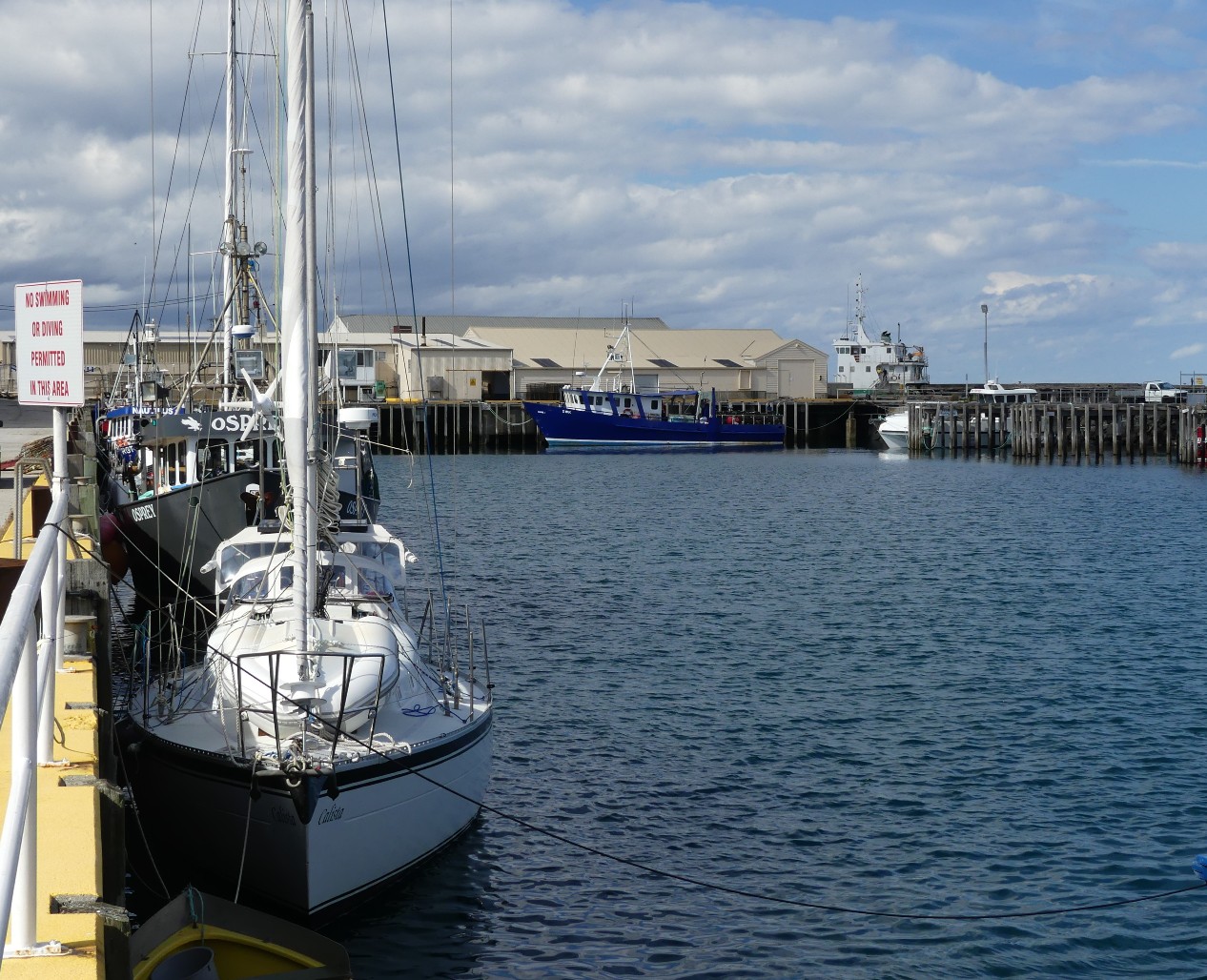
When tidal rivers flow out to sea, tides at their mouths are impacted by what the experts call overfall. An outrunning tide, depending on its volume of outflow, does not stop with the change of tide out to sea. It is like a runaway train that takes a time to grind to a halt. Because of the Tamar’s volume, we found the river to be still running seaward, well into the incoming tide.  Although large ships enter the stream, bound, for example for Bell Bay, our eight tonne vessel was gripped and thrown by the swirl of the outflow as we made our way upstream. Eventually, though, we were through the worst of it, and by following the beacons and leads we found our way upstream to the Beauty Point Marina, an offshoot of Launceston’s Tamar Yacht Club. Here, alongside the Australian Maritime College, we looked forward to a secure tie-up and making some new discoveries. True to his word, Lionel, the ever friendly and helpful retiree who manages the facility was there to take our lines. It was great to be in because, out across the Tamar, the nor-wester was on the rise.
Beauty Point Marina approach